liveBook · Manning

Network address translation

As explained in Fundamentals of Cybersecurity

Network Address Translation is a technique that rewrites network addresses in packet traffic to map between internal and external addressing contexts.

Network Address Translation (NAT) rewrites addresses in packet traffic to map between internal and external networks. IP addresses help routers locate devices and deliver data across networks—much like street addresses help a delivery van find a house. NAT matters when traffic moves between different addressing contexts. section 11.5.2

Figure 11.7 Illustration of Network Address Translation (NAT)
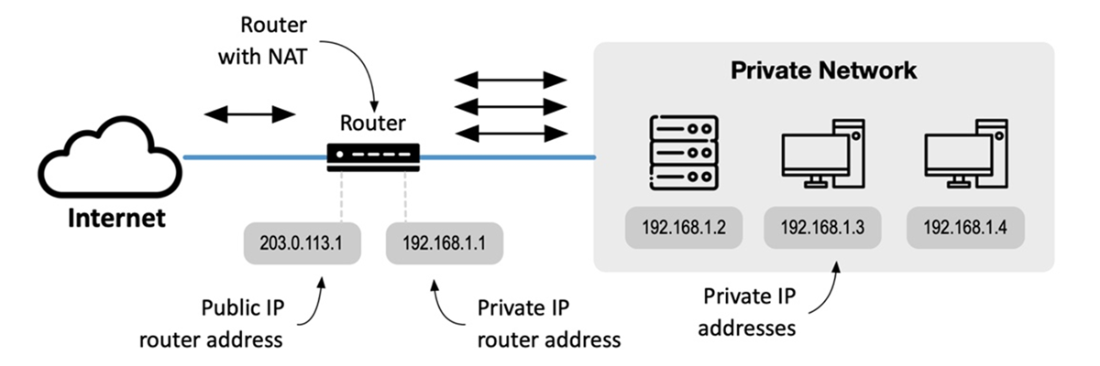
The NAT diagram provides a visual way to follow the address mapping between networks. section 11.5.2


How Fundamentals of Cybersecurity covers it

How deep it goes
Illustrates NAT but does not provide configuration steps or packet-level detail.
Examples
Uses a NAT diagram and compares IP addresses to street addresses for routing context.
What it assumes
Introduces IP addresses through their roles in identifying devices and guiding routing.
What you can do after
Evaluate/understand NAT as address mapping between internal and external networks.
How it connects
Connects NAT to IP addresses and routing between networks.

Also explained in

Compare how 3 books explain network address translation →

Related concepts

This explainer was generated by Manning's knowledge graph from the text of Fundamentals of Cybersecurity. The section links point to the parts of the book it draws on.
