A node is an entity or vertex in a network or graph. It participates in connections to other nodes, or represents an item in a hierarchy. Hierarchical nodes form parent-child structures; network nodes can have many-to-many relationships. section 11.0 section 12.0
Use nodes differently depending on the visualization:
- In a circle pack, treemap, or tree chart, nodes occupy hierarchical levels from a single root through branches to leaf nodes. section 11.0
- In a network, nodes represent connected things, while edges or links represent relationships between them. section 12.0
- A node dataset can store relevant attributes such as a name, group, description, and numeric value. section 12.1
Romeo and Juliet character network
Represent each character as a node with fields such as name, house, description, and number of lines. Add an undirected edge whenever two characters share a scene, and use its weight to record how many scenes they share. A visualization can then show both the characters and their relationships. section 12.1
Figure 12.2 Network edges have a source and a target. In directed networks, the direction of the connection is meaningful and often represented by an arrow. In undirected networks, there’s no specific direction to the relationship.
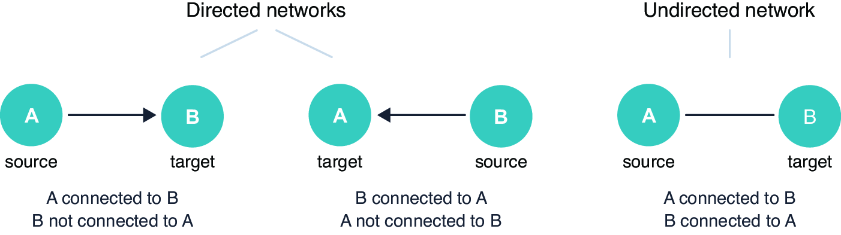
Compare directed and undirected connections: directed edges have meaningful source-to-target direction, while undirected edges represent relationships valid in both directions. section 12.1


















