liveBook · Manning

Node

As explained in Grokking Machine Learning

A structural element of a tree that can contain a question or prediction and connect to branches.

A node is a point in a decision tree. A decision node holds a yes-or-no question and sends each answer along a branch; a leaf has no branches and represents the end of the decision. section 9.0

Nodes can occupy different positions in the tree:

  • The root node is at the top and contains the first question. section 9.0
  • Decision nodes ask questions; leaf nodes have no outgoing branches. section 9.0
Figure 9.2 A regular decision tree with a root node, decision nodes, branches, and leaves. Note that each decision node contains a yes-or-no question. From each possible answer, one branch emanates, which can lead to another decision node or a leaf. This tree has a depth of 2, because the longest path from a leaf to the root goes through two branches.
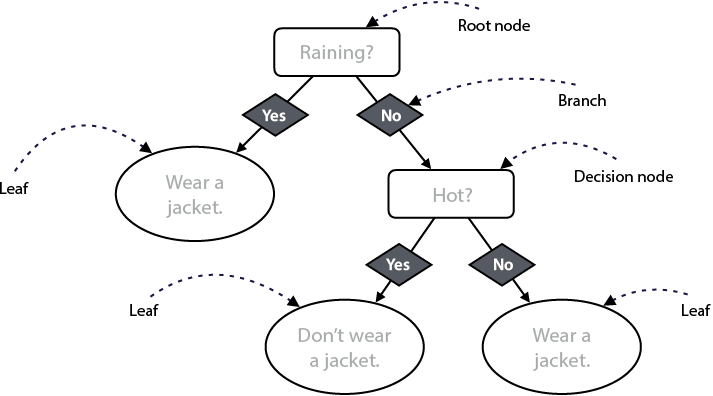
See how question-holding nodes connect by branches to further questions or leaves. section 9.0


How Grokking Machine Learning covers it

How deep it goes
Defines root, decision, and leaf nodes by their positions and branches, without detailing how questions are learned.
Examples
Illustrates nodes with a jacket decision based on whether it is raining and, if not, the temperature.
What it assumes
Starts from a familiar jacket decision and defines tree terms in plain language.
What you can do after
Understand how questions and branches form a decision tree used to make a prediction.
How it connects
Connects nodes to decision trees, binary trees, branches, root nodes, and leaf nodes.

Also explained in

Compare how 19 books explain node →

Related concepts

This explainer was generated by Manning's knowledge graph from the text of Grokking Machine Learning. The section links point to the parts of the book it draws on.
















