When threads read down the columns of a shared-memory tile, their addresses can all map to the same bank, forcing accesses to run in sequence. Padding adds an unused spacer column to shift each row’s starting address and spread those accesses across banks. section 11.8 section 11.11
Figure 11.8 The padding trick on a toy 4-bank GPU: without padding (arr[4][4]), row-major storage places every column-0 element at a multiple-of-4 address, so all four land in bank 0 (a 4-way conflict). Adding one padding column (arr[4][5]) shifts each row’s start by one, moving the four accesses into four different banks, so the conflict disappears.
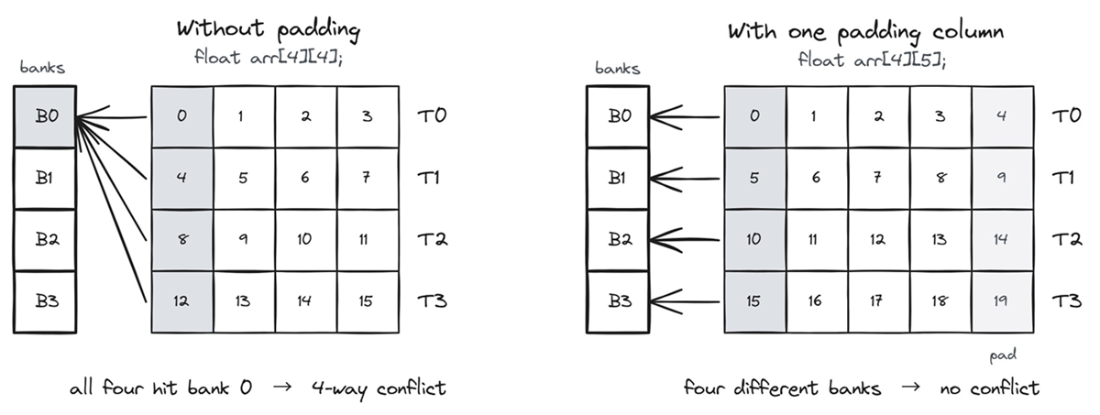
The toy four-bank example shows how changing arr[4][4] to arr[4][5] spreads column-zero accesses across banks. section 11.8
A spacer column
For a 32 × 32 tile, changing tile[32][32] to tile[32][33] spreads a column’s accesses across 32 banks. The extra column costs 3.125% more shared memory; threads still use only columns 0–31. section 11.8
Padding can also mean extending a Blelloch scan’s input to the next power of two with the identity value for addition, zero. Ignore the added positions afterward. For scan bank conflicts, padding shared-memory indices can help, but profile before implementing it; libraries such as CUB handle this automatically. section 7.12 section 7.11