Precision measures how often positive predictions are correct. It answers a practical question: when a model labels an instance as positive, how often is that decision right? section 12.1.5
Use precision as part of a broader evaluation workflow:
- Compare precision with recall, which measures how many existing target instances the model finds. section 12.1.5
- Use F1-score when evaluation needs to balance prediction correctness with finding as many correct instances as possible. section 12.1.5
- For imbalanced classes, select an appropriate averaging method; weighted averaging reflects the distribution of licit and illicit nodes. section 12.1.5
- Evaluate extraction systems per class for entities and relations, then use the results to identify systematic failures and monitor model drift. section 5.3.3
AML node classification
For a graph model classifying nodes as licit or illicit, precision asks how often each prediction is correct. GCN, GAT, and SAGE precision can be compared on the validation dataset during training. section 12.1.5
Figure 12.5 Performance of GCN, GAT, and SAGE across precision, recall, and F1-score on the validation dataset during the training phase
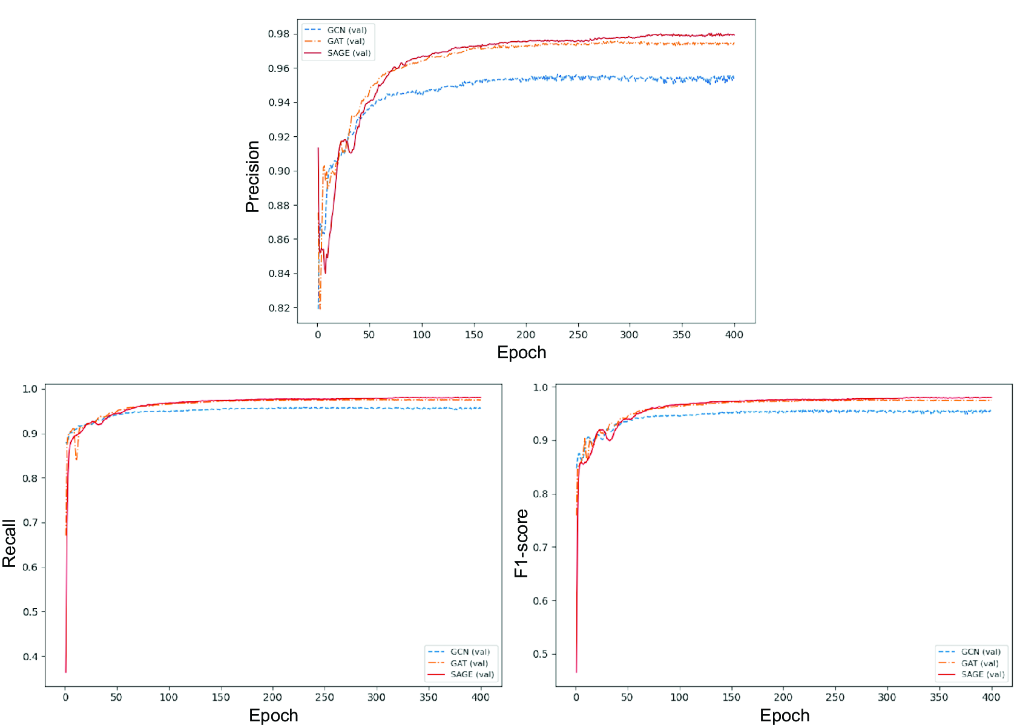
Compare GCN, GAT, and SAGE across precision, recall, and F1-score over training epochs. section 12.1.5
Figure 12.6 Confusion matrices to understand the performance of GCN, GAT, and SAGE models on each class (licit or illicit)
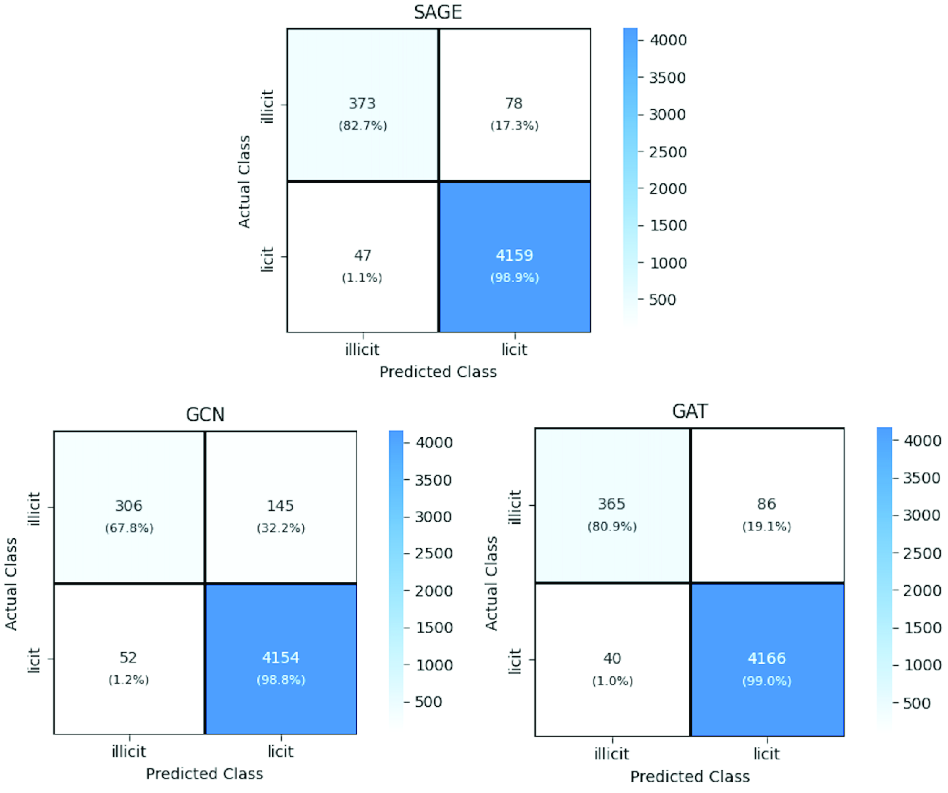
Inspect class-specific confusion matrices to understand where correct and incorrect licit or illicit predictions affect precision. section 12.1.5



















