Precision asks: how much of a system’s output meets the matching criterion? For text generation, it is the number of candidate words or n-grams found in a reference, divided by the total number of candidate words or n-grams. An n-gram is a contiguous sequence of n tokens. section 2.1.2
Counting word matches
For the candidate “cat is missing” and the reference “The cat is on the mat,” two of the candidate’s three words match. The unigram precision is 2/3. The score says how much of the candidate overlaps, not whether the candidate expresses the reference’s full meaning. section 2.1.2 section 2.0
Naive word counting can be misleading. A candidate that repeats “the” seven times overlaps with references containing “the,” but is not a useful translation. BLEU addresses evaluation through modified n-gram precision at several n-gram lengths, combining the scores and applying a brevity penalty. section 2.1.2 section 2.1.1
Figure 2.1 The BLEU evaluation pipeline from input to final score. BLEU takes generated candidates and references, calculates word overlaps for different word segment lengths, combines these scores using a geometric mean, and applies a length penalty to produce the final score.
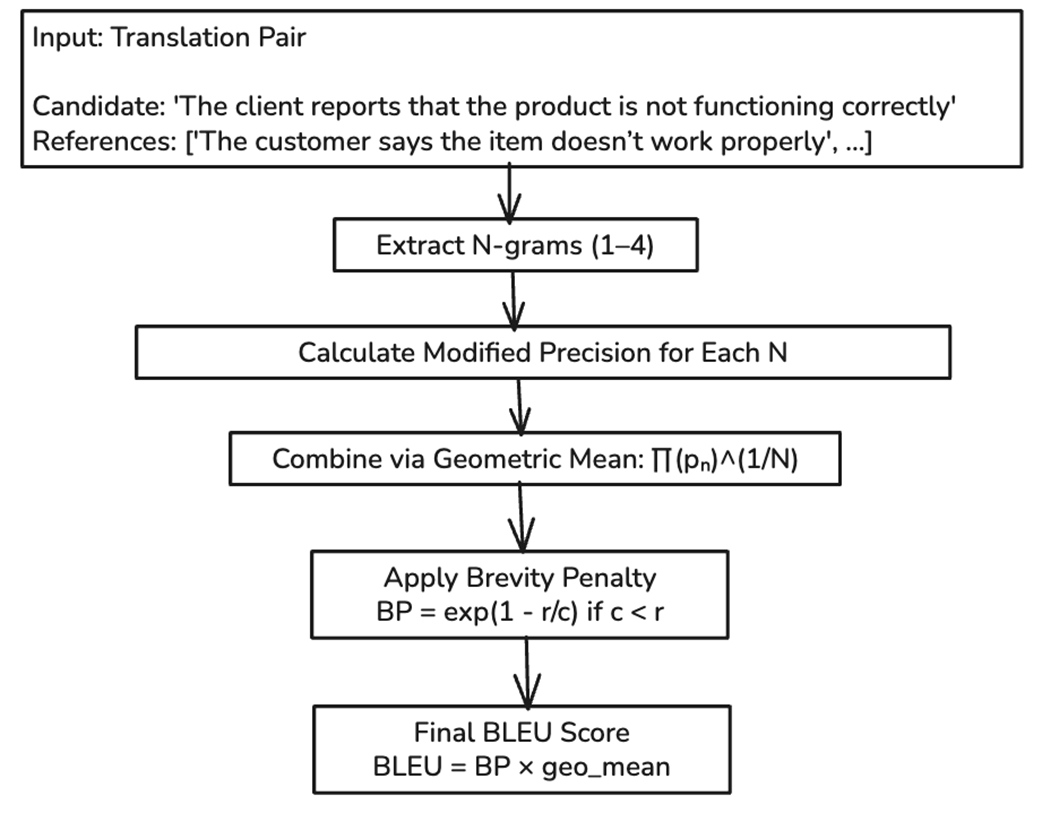
Follow how BLEU combines n-gram overlap scores and a length penalty into a final score. section 2.1.1
Recall reverses the question: how much of the reference appears in the candidate? A short output can have high precision while missing important information. ROUGE emphasizes recall for summarization, and an F-measure combines precision and recall when both matter. section 2.2.1 section 2.2.2
Choose the metric for the task. Precision favors outputs that avoid unmatched content; recall favors coverage. Exact lexical overlap can miss valid paraphrases, so a high or low score alone is not a universal judgment of quality. Precision also appears in retrieval evaluation, where the question is whether retrieved documents are relevant. section 2.2 section 6.0 section 2.0


























