Prompt engineering is the deliberate design and refinement of natural-language instructions that guide a language model toward useful, accurate, and relevant outputs. It is fundamentally a communication skill: translate your intent into a task the model can interpret and execute. section 3.0
Why specificity matters
“Tell me about electric cars” leaves the model guessing whether you want purchase costs, charging infrastructure, maintenance, environmental impact, or driving range. Adding your situation, a specific objective, and delivery instructions reduces that guesswork. section 3.1
Build a well-structured prompt from three complementary parts:
- Context explains who you are, what you are trying to achieve, your constraints, and what you already know. section 3.1
- The main point states the specific task or objective you want the model to perform. section 3.1
- Action controls delivery through format, audience, tone, length, detail, structure, language, or perspective. section 3.1.3
- Examples can guide behavior through zero-shot, one-shot, or few-shot prompting, while conversations support refinement and exploration. section 3.5
Figure 3.1 The three components of a well-structured prompt, each answering a different question.
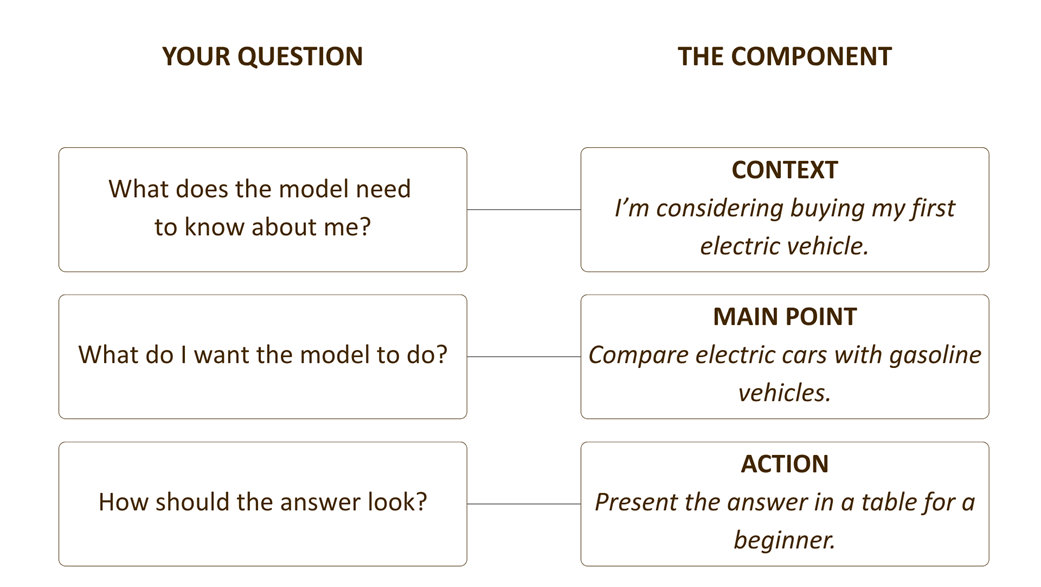
Use the three-part prompt structure as a visual checklist: identify the situation, define the task, and specify the response. section 3.1
Table 3.2 Common Prompt Actions
|
If you want to control…
|
Examples
|
Prompt template
|
|
Output format
|
Table, bullet list, report, email, JSON, CSV
|
Present the answer as [desired format]
|
|
Audience
|
Beginner, high-school student, manager, software engineer,
executive
|
Explain this to [target audience]
|
|
Tone
|
Formal, professional, conversational, persuasive,
enthusiastic
|
Use a [desired tone] tone
|
|
Length
|
One paragraph, 100 words, five bullet points, detailed
analysis
|
Limit the response to [desired length]
|
|
Language
|
English, Italian, Spanish, French
|
Write the response in [language]
|
|
Level of detail
|
High-level overview, executive summary, technical deep
dive
|
Provide a [desired level of detail]
|
|
Structure
|
Step-by-step instructions, pros and cons, comparison
matrix, FAQ
|
Organize the answer as [desired structure]
|
|
Perspective
|
Cost, sustainability, security, business impact, customer
experience
|
Focus on [specific perspective]
|
Consult the action patterns when the response needs a particular format, audience, tone, length, language, detail level, structure, or perspective. section 3.1.3
Prompting differs from programming. Programming specifies how a task must be performed; prompting communicates the desired outcome and lets the language model determine how to generate a response from learned patterns. Clear prompts improve results but do not remove hallucinations, overconfidence, bias, prompt injection, or jailbreaking risks. section 3.1.3 section 3.5