Memory allows past experience to shape present behavior, but similar outcomes can arise through different processes. Human remembering is reconstructive: recall can reactivate and subtly modify the patterns supporting a memory. What is remembered is also shaped by emotion, motivation, prior experience, and the conditions in which the memory formed. section 5.4.3
In a trained neural network, prior experience is embedded in parameters that shape how inputs become outputs. Ordinary use accesses this structure without changing it. The model can produce varied responses, but those responses do not by themselves revise its parameters; changes require a new training process. section 5.4.3
Figure 5.3 Human memory is reconstructive: experiences form memories that are reshaped each time they are recalled, so remembering can modify the structure that supports future recall. Artificial neural networks instead store prior experience in model parameters created during training. During inference these parameters remain fixed, so using the model does not alter its stored knowledge.
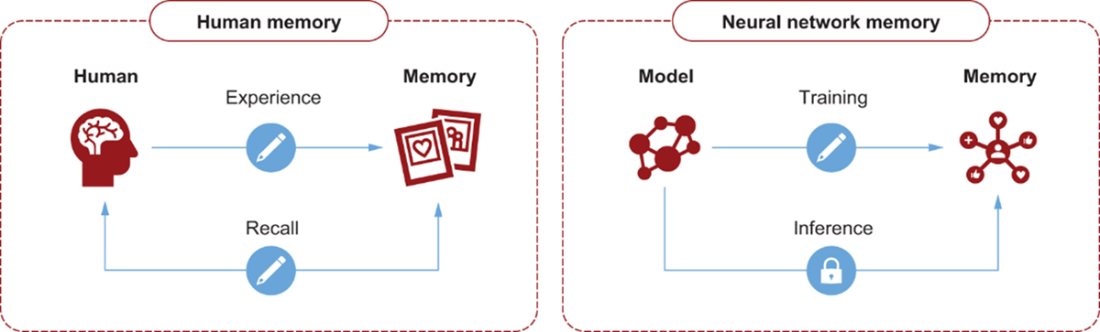
The figure contrasts recall that can reshape human memory with fixed model parameters during inference. section 5.4.3
Conversational continuity is distinct from changing a model’s parameters. Prompts and corrections can influence behavior within a conversation, but they do not normally alter the underlying model. Memory systems, fine-tuning, or external learning loops can be added to preserve corrections or accumulate experience. section 9.4.4
A system may recall prior exchanges and, through memory and personalization, make an interaction feel continuous. That continuity should not be confused with a shared relationship: the user may attach meaning to the exchange while the system responds without awareness, commitment, agency, or responsibility. section 8.5.4

























