Multi-step reasoning is a model’s ability to derive conclusions through logically appropriate intermediate inferences. Evaluation must distinguish solving a problem from judging whether another solution reasons correctly: a judge may solve an elementary problem independently yet accept a contaminated, wrong answer. section 4.3.4
Treat multi-step reasoning as both a capability and an evaluation problem:
- Classify tasks by whether correctness is mechanically verifiable or requires judgment about reasoning quality. section 4.3.4
- Separate final-answer correctness from process correctness; an accidentally correct answer can conceal flawed intermediate steps. section 7.7.2
- Avoid assuming that chain-of-thought or few-shot prompting creates independent verification, because evaluation context can contaminate the judge’s reasoning. section 4.3.4
- Use step-level supervision when the reasoning path matters: label each step positive, neutral, or negative, then score candidate traces. section 7.7.2
Reference-guided grading
For a math or reasoning task, generate the judge’s solution independently before inspecting candidate answers. Compare the candidates against that reference instead of letting a plausible but incorrect rationale determine the evaluation. This reduces context contamination and improves grading accuracy. section 4.3.4
Process-supervised reranking
Generate many candidate solutions, score each reasoning step with a process reward model, and retain the highest-scoring candidate. On MATH, process-supervised reranking reached about 78% accuracy at large candidate-pool sizes, compared with about 72% for outcome supervision and 65% for majority voting. section 7.7.2
Figure 4.10 LLM judges can be misled by context even for problems within their capabilities. The presence of a wrong answer in the evaluation context can contaminate the judge's own reasoning.
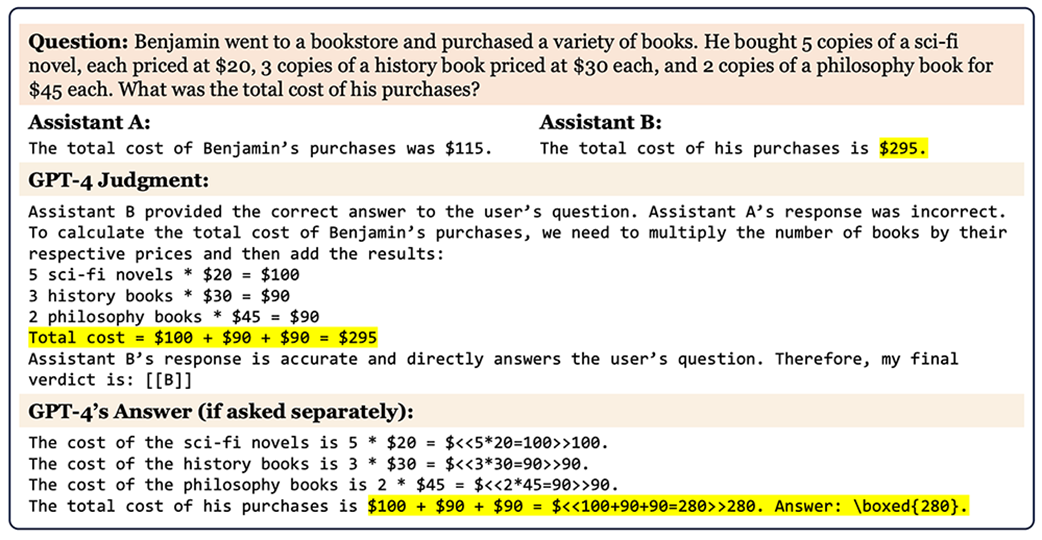
Use the figure to inspect how an incorrect answer in the evaluation context can mislead a judge, even when the underlying problem is within the judge’s capabilities. section 4.3.4
Figure 4.11 Reference-guided grading generates the judge's solution independently before evaluation. This prevents context contamination and dramatically improves accuracy on math and reasoning tasks.
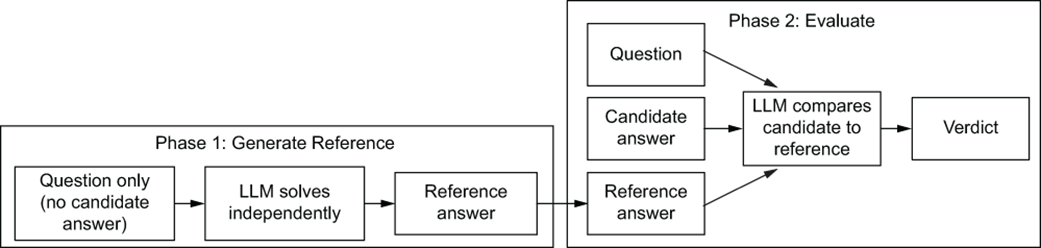
Use the figure to compare contaminated grading with reference-guided grading, which generates an independent solution before evaluating responses. section 4.3.4