Chain-of-thought is the practice of prompting a language model to produce intermediate reasoning steps before a final answer. Instead of answering in one jump, the model builds a sequence of smaller moves, which can help with problems whose steps depend on earlier results. section 9.2.1
Each generated step becomes context for the next. Partial results can therefore guide later tokens, even though generation remains a predictive process. Intermediate steps can also make assumptions and errors easier to notice. section 9.2.1 section 9.2.3
Figure 9.4 Direct answer versus chain of thought. A direct answer can jump to a plausible but incorrect result, while a chain of thought decomposes the problem into intermediate steps that provide structured context for the final answer.
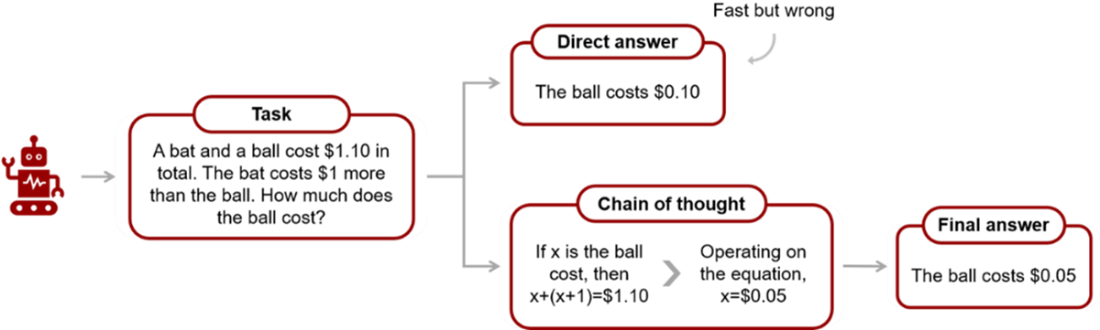
Compare a direct answer with a sequence of intermediate steps that supplies context for the final answer. section 9.2.1
The approach extends beyond a single sequence. Self-consistency samples several reasoning paths and selects the most consistent answer. Tree of Thoughts branches and evaluates paths, while Graph of Thoughts represents intermediate thoughts and their dependencies as a graph. section 9.2.1
A chain can serve as a computational scaffold or an explanation, but it can also be a misleading account of how an answer arose. Its success does not establish human-like understanding, and structured reasoning does not eliminate unsupported conclusions. section 9.2.3 section 6.5