Recall measures how many actual positive examples a classifier correctly identifies as positive. It emphasizes finding positives rather than avoiding false alarms, so it complements precision and helps reveal class-specific weaknesses. section 9.3.1 section 4.4.2
Read recall operationally:
- For each class, inspect the class-specific recall rather than relying only on overall accuracy. section 4.4.2
- Use recall as a scoring criterion when the ability to recover positive cases matters. section 9.3.1
- Compare recall with precision, F1-score, accuracy, and balanced accuracy to understand different error priorities. section 4.4.2
Digit classification
An AdaBoost classifier reaches recall of 0.58 for digit 9, while most other classes reach 0.97 or 1.00. The overall accuracy of 0.95 therefore hides a specific class-level weakness: many actual 9s are assigned to another class. section 4.4.2 section 4.4.2
Figure 9.8 Feature importances computed by XGBoost versus black-box permutation feature importances computed for the XGBoost model using two different metrics: balanced accuracy and recall
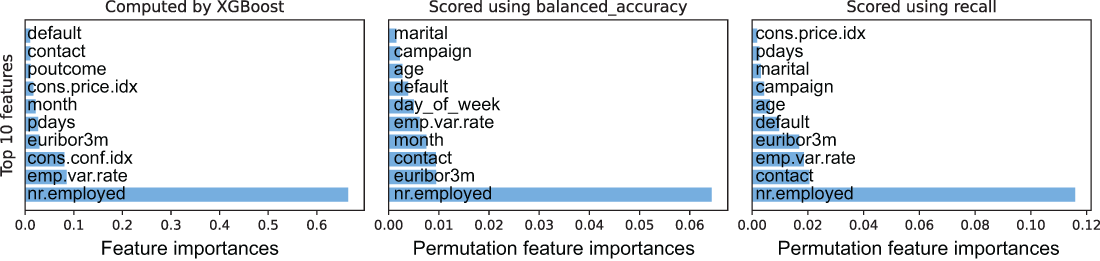
Compare feature importances computed with balanced accuracy and recall to see how the evaluation metric changes a model-agnostic feature-importance analysis. section 9.3.1























