Recall asks a simple question: of all the positive cases that really occurred, how many did a classifier catch? It is also called the true positive rate (TPR). For a wolf-warning system, recall measures the share of real wolf appearances that triggered an alarm—not the share of alarms that were right. section 8.9 section 8.10
Calculate recall as TP / (TP + FN): true positives divided by all actual positives. True positives are cases correctly labeled positive; false negatives are positive cases the model missed. True negatives do not enter the calculation, because recall focuses only on finding the event of interest. section 8.10 section 8.9
Wolf alarms: accuracy can hide missed positives
Imagine wolves are rare. A detector can achieve 98% accuracy simply by almost always predicting “no wolf,” yet have 0% recall if it catches none of the real wolves. When missing a wolf matters, recall reveals a failure that overall accuracy can make look harmless. section 8.9
Recall and precision pull in different directions when the classification threshold changes. Lowering a logistic-regression threshold labels more cases positive, which can catch more real positives and increase recall—but it can also create more false alarms, lowering precision. Raising the threshold can improve precision while allowing more positives to slip through. section 8.10
Figure 8.8 The receiver operating characteristic (ROC) curve for my logistic regression toddler meltdown prediction, across different thresholds
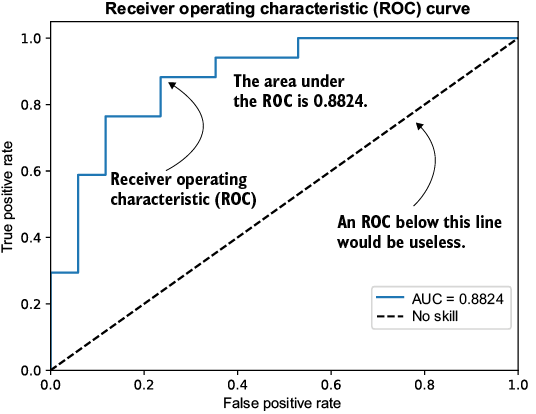
Use the ROC curve to see recall as the true positive rate across many thresholds, alongside the false-positive rate. Each point represents a different compromise rather than one universally correct cutoff. section 8.10
Choose recall according to the cost of a missed positive. A cautious caregiver might use a lower meltdown-prediction threshold to catch more possible meltdowns and take more preventative naps. That choice accepts extra false alarms; a higher threshold avoids some alarms but risks missing more meltdowns. section 8.10
Recall is not a complete score by itself. Pair it with precision to learn whether positive predictions are usually correct, and inspect the precision-recall curve or ROC curve when many thresholds are possible. The useful balance depends on whether missed events or false alarms cause more trouble. section 8.10 section 8.9























