liveBook · Manning

Recall

As explained in Machine Learning Algorithms in Depth

The proportion of actual positive examples correctly predicted as positive.

Recall is the proportion of actual positive examples predicted as positive. For a binary classifier, recall, also called true positive rate (TPR), is Recall = TP/(TP + FN), where TP counts true positives and FN counts false negatives. section 5.2

Use recall to interpret classifier performance:

  • A higher recall means fewer actual positives are missed as false negatives. section 5.2
  • Changing the classification threshold changes TP, FN, and therefore recall. section 5.2
  • Precision and recall together form a precision-recall curve; their fixed-threshold harmonic mean is the F1 score. section 5.2
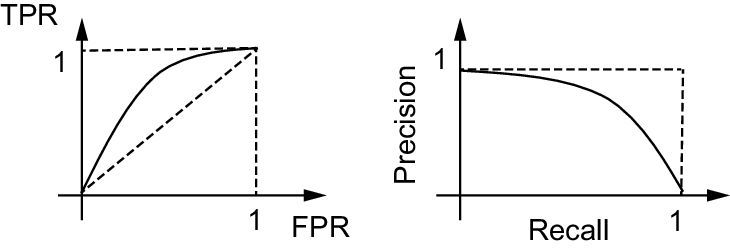
Figure 5.4 Receiver operating characteristic (ROC) plot (left) and precision-recall plot (right)
figure

Compare precision and recall across classification thresholds with a precision-recall plot. section 5.2


How Machine Learning Algorithms in Depth covers it

How deep it goes
Defines recall algebraically and relates it to thresholds, confusion matrices, precision-recall curves, and F1, without deriving implementation details.
Examples
Uses TP and FN counts, threshold variation, and precision-recall plots as concrete interpretive examples.
What it assumes
Assumes binary classification and confusion-matrix terminology while defining recall from true-positive and false-negative counts.
What you can do after
Evaluate binary classifiers by calculating recall and interpreting its tradeoff with precision across thresholds.
How it connects
Connects recall with true positive rate, confusion matrices, false negatives, precision, classification thresholds, precision-recall curves, and F1 score.

Also explained in

Compare how 24 books explain recall →

Related concepts

This explainer was generated by Manning's knowledge graph from the text of Machine Learning Algorithms in Depth. The section links point to the parts of the book it draws on.





















