Recall measures the proportion of relevant positive instances that a model successfully identifies. It answers: of all existing licit and illicit nodes, how many did the model correctly find? section 12.1.5
Recall is useful when missed positives matter, such as failing to identify illicit nodes in an AML graph. Read it alongside precision, which measures how often positive predictions are correct, and F1-score, which balances both concerns. section 12.1.5
Evaluate recall through a practical validation workflow:
- Collect predictions for labeled entities or relations and mark each prediction as correct, incorrect, or missing. section 5.3.3
- Calculate recall per class, alongside precision and F1-score, rather than relying on a handful of qualitative examples. section 5.3.3
- Use validation plots to compare recall across training epochs and models such as GCN, GAT, and SAGE. section 12.1.5
- Choose an averaging strategy deliberately for imbalanced data; weighted averaging reflects the distribution of licit and illicit nodes. section 12.1.5
AML node classification
A graph model classifies nodes as licit or illicit. Recall reports how many nodes from both existing classes the model finds correctly, while precision reports how often its classifications are right. section 12.1.5
Figure 12.5 Performance of GCN, GAT, and SAGE across precision, recall, and F1-score on the validation dataset during the training phase
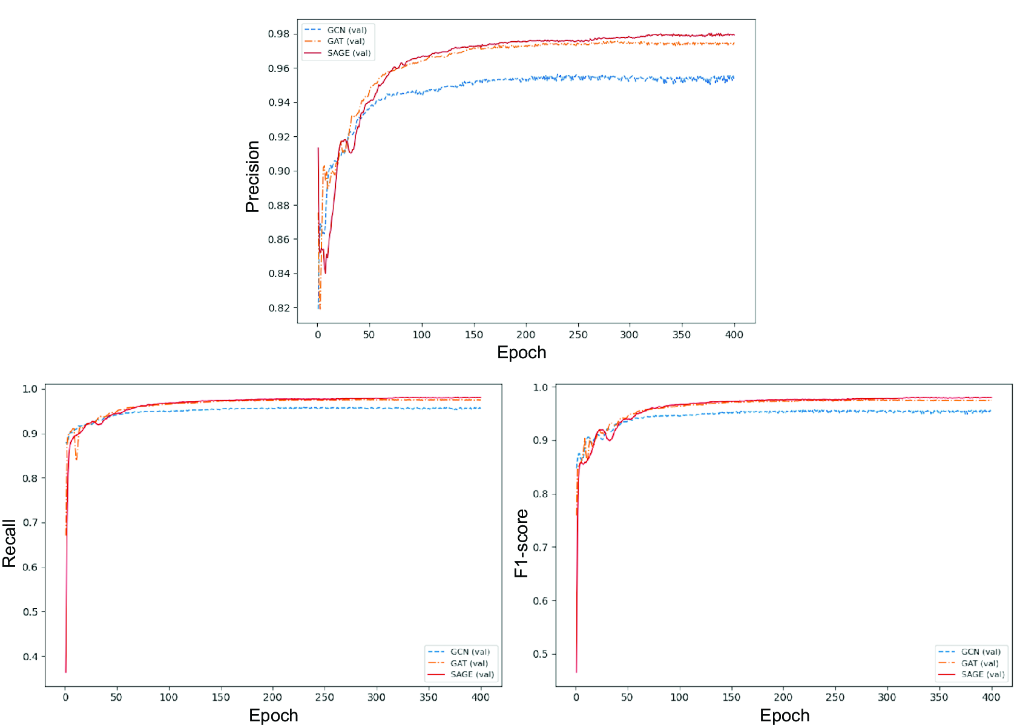
Compare GCN, GAT, and SAGE recall across precision, recall, and F1-score during validation training. section 12.1.5
Figure 12.6 Confusion matrices to understand the performance of GCN, GAT, and SAGE models on each class (licit or illicit)
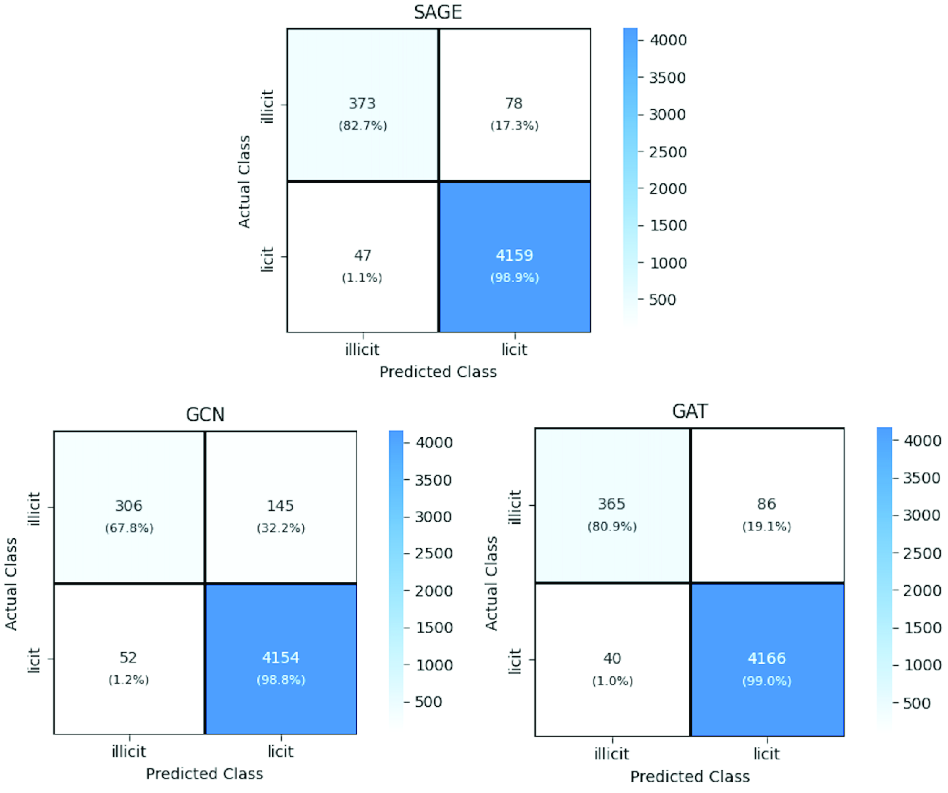
Inspect class-level confusion matrices to understand which licit or illicit instances contribute to recall performance. section 12.1.5























