Return on investment (ROI) compares the value or financial return generated by an investment with its cost. For platform engineering, ROI models the value of removing wasted developer time, inefficient infrastructure spending, and governance or security risk. section 3.2.2
Use ROI to guide platform investment decisions:
- Project expected returns to secure investment before building or expanding the platform. section 3.2.2
- Assess actual value afterward to decide where to continue investing or stop. section 3.2.2
- Model the financial effect of removing waste rather than treating platform capabilities as value by themselves. section 3.2.2
Earlier delivery and additional income
If an engineering platform removes wasted time equal to 33% of developers’ total time, software can ship sooner. With a backlog expected to generate $10 million per month, shipping four months earlier produces $40 million in additional income, alongside four months of additional software delivery. section 3.2.2
Figure 3.5 Components of value modeling process. These are both subjective and objective measurements that a technical product owner should identify by working with stakeholders and engineers, which will be used to show platform value.
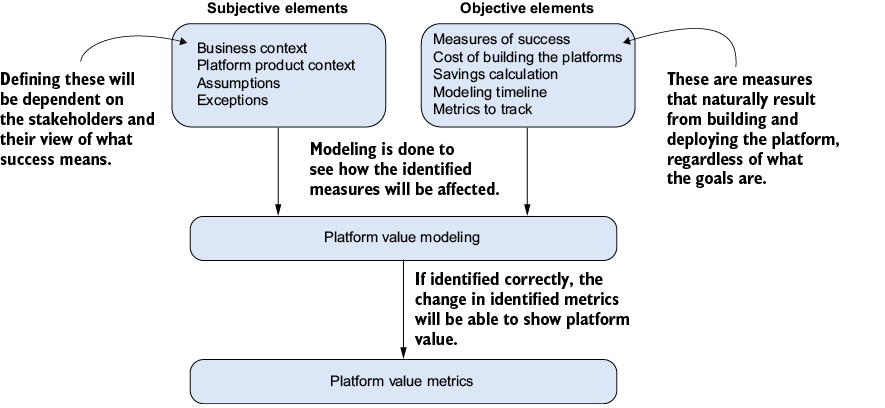
Map subjective and objective measurements with technical product owners, stakeholders, and engineers to build a platform value model. section 3.2.2










