Logistic regression is a supervised classification method for estimating whether an event occurs. In a telecom churn problem, revenue, service duration, average cost, and monthly usage act as independent variables, while churn status is the target. section 1.5.1
The model fits an equation and passes its result through a sigmoid function, producing a probability between 0 and 1. Binary logistic regression addresses yes/no outcomes; multiple logistic regression extends the classification setting. section 1.5.1
Interpret the core terms as follows:
- The logit is log(p/(1 − p)), and the odds are p/(1 − p). section 1.5.1
- The intercept β0 and coefficients such as β1 connect input variables to the logit. section 1.5.1
- Linear regression is unsuitable for probability scores because it can produce values below 0 or above 1. section 1.5.1
Telecom churn
Historical records label subscribers such as 1001 and 1004 as churned and 1002 and 1003 as not churned. A logistic model uses their attributes to generate a churn probability for a new customer. section 1.5.1
Figure 1.14 A linear regression model will not be able to do justice (left); hence, we have logistic regression for classification. Linear regression can generate probability scores more than 1 or less than 0 too, which is mathematically incorrect, whereas the sigmoid function generates probability scores between 0 and 1 only (right).
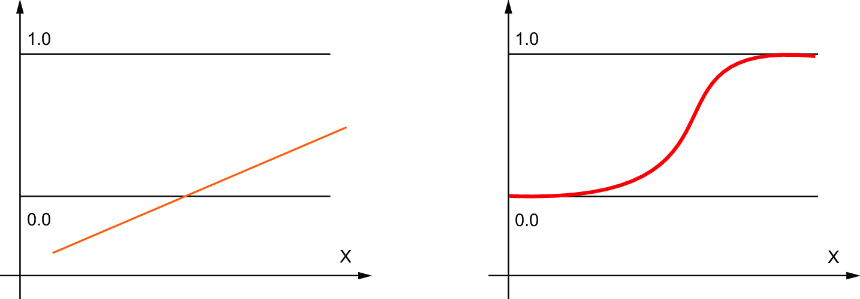
Compare the invalid probability range produced by a linear model with the sigmoid curve’s bounded output. section 1.5.1











