Symmetry means that corresponding parts mirror one another around a center. In a normal distribution, the bell curve has matching left and right sides, with the mean at its center. section 4.2 section 4.1
Use these cues to read symmetry in a distribution:
- The mean divides the total area into two equal halves. section 4.2
- Values cluster near the center and become less likely toward matching tails. section 4.1
- Changing the mean shifts the curve, while changing the standard deviation changes its width without changing the total area. section 4.2
A symmetric confidence interval
For a central area of .95 under the standard normal curve, split the remaining .05 equally between the tails: .025 on each side. The matching boundaries are critical Z-values of approximately ±1.96. section 5.3
Figure 5.4 Breaking down the center .95 area in the bell curve and demonstrating the symmetry
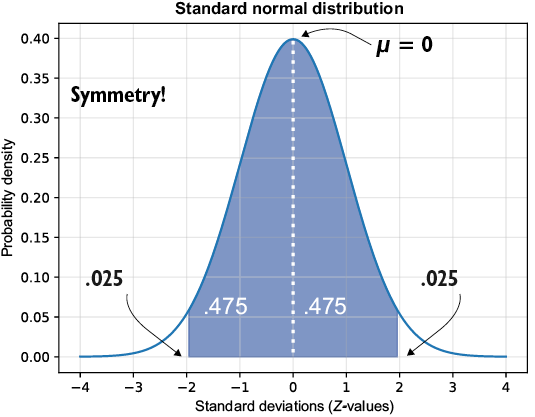
See how the central .95 area folds evenly around the mean and leaves equal tail areas. section 5.3



