liveBook · Manning

Sequence

As explained in Machine Learning System Design

Data consisting of observations indexed or ordered by time.

A sequence is data ordered by time. Neighboring observations, such as daily sales or recent user actions, can share information, so future data must not inform predictions about the past. section 7.2.4

When working with time-series data, consider two practical uses:

  • Validate models with splits ordered by timestamp, then choose training and test windows that reflect forecast horizons, retraining schedules, and seasonality. section 7.2.4
  • Create features from past values using lags, time-window aggregates, or statistics such as standard deviation and variance. section 11.1.2
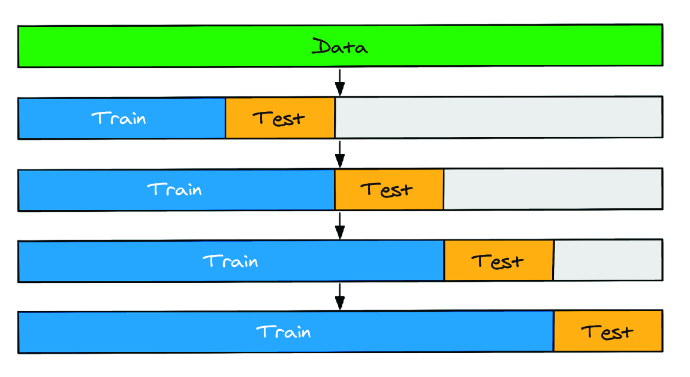
Figure 7.4 Standard time-based split. The test dataset always follows the train one, so train samples are “past” and test is “future.”
figure

A diagram of the basic rule: training data comes from the past, and testing data follows it in the future. section 7.2.4


How Machine Learning System Design covers it

How deep it goes
Explains timestamp-based splits and discusses window size, training history, seasonality, and gaps.
Examples
Uses neighboring-day sales, recent user actions, lag features, and statistics calculated over past time windows.
What you can do after
Evaluate models with timestamp-ordered splits and create past-based features using lags, aggregates, or statistical summaries.
How it connects
Connects time-series validation with holdout sets and cross-validation, and feature generation with lags and window aggregates.

Also explained in

Compare how 22 books explain sequence →

Related concepts

This explainer was generated by Manning's knowledge graph from the text of Machine Learning System Design. The section links point to the parts of the book it draws on.



















