liveBook · Manning

Token

As explained in Claude at Work

A token is a unit of text processed by a language model, typically representing part of a word, a word, or punctuation.

Tokens measure the text Claude reads and generates. A token is roughly three-quarters of a word, so a 1,000-word document is about 1,300 tokens, plus the question you ask about it. section 1.4.1

Token counts affect two limits:

  • Usage limits track consumption; reaching a limit can pause responses until it resets. section 1.4.1
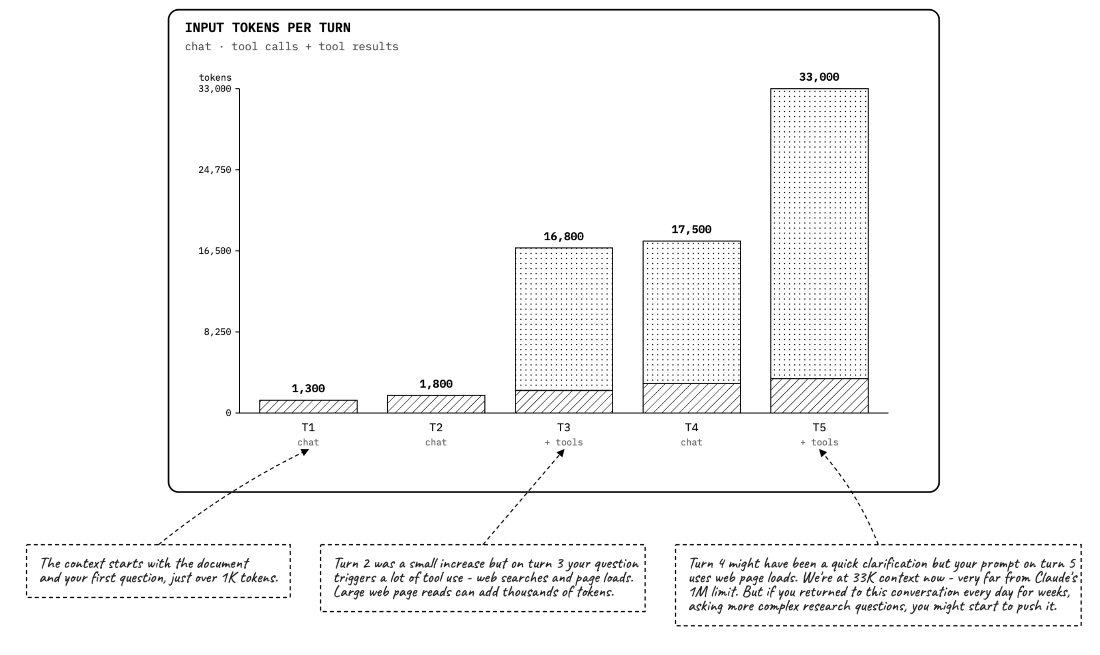
  • The conversation context accumulates across messages and responses. Tool use, such as researching web pages or files, can add thousands of tokens in a turn. section 1.4.1

Estimate a document

A 1,000-word document is approximately 1,300 tokens before adding the prompt. Treat this as a rough estimate, not an exact count. section 1.4.1

Figure 1.2 How context builds over the turns of a conversation. The input grows cumulatively and there can be huge jumps from tool use when Claude is researching file content or web pages.
CH01 F03 Stoneman

See how conversation context grows over turns, with tool use producing large jumps. section 1.4.1


How Claude at Work covers it

How deep it goes
Defines tokens as a usage measure, estimates their size, and explains limits without describing tokenization internals.
Examples
Estimates a 1,000-word document at about 1,300 tokens and notes that web or file research can add thousands per turn.
What it assumes
Assumes no deep technical knowledge and focuses on the practical significance of tokens.
What you can do after
Understand how prompts, responses, and tool use add to token consumption and conversation context.
How it connects
Connects tokens to context windows, prompts, model choice, and tool use.

Also explained in

Compare how 40 books explain token →

Related concepts

This explainer was generated by Manning's knowledge graph from the text of Claude at Work. The section links point to the parts of the book it draws on.





































