Throughput measures how much data a system can process within a defined time window. Higher throughput increases the volume an ingestion pipeline or storage system can handle, but does not necessarily reduce delivery latency. section 6.1.1 section 5.5.1
Architecture decisions must balance throughput with freshness, latency, reliability, schema evolution, operational complexity, and Iceberg’s metadata behavior. Batch systems favor sustained volume; streaming systems favor continuous delivery. section 6.1 section 6.0
High-throughput Iceberg ingestion typically requires:
- Parallel processing, bulk writes, batching, and appropriately sized files. section 6.5.2
- Compaction, partition tuning, snapshot expiration, and controlled commit frequency to limit metadata growth and read amplification. section 6.5.2
- Automated schema validation and evolution so source changes do not interrupt ingestion. section 6.5.2
- Tool selection based on workload: Spark for scheduled or backfill volume, and Flink or Kafka-based pipelines for controlled continuous writes. section 6.1.1
Media event ingestion
A streaming-media company processing more than 100 billion daily playback events can use Flink with Kafka checkpointing, deduplication, partitioning, and batched Iceberg commits. Redpanda or Qlik can manage many topics, while compaction and file-size optimization stabilize downstream queries. section 6.5.2
Figure 6.1 The more records a system can process in the same time window, the higher the throughput it can handle.
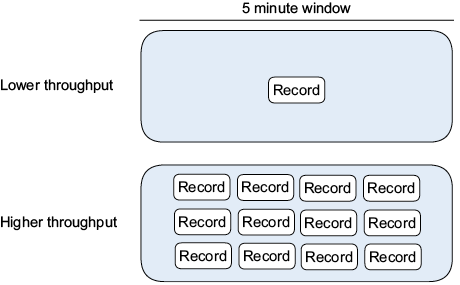
Illustrates throughput as the number of records processed during the same time window. section 6.1.1



















