Throughput is how much processing a system successfully handles over time. In Azure Cosmos DB, request units per second provide a practical way to plan and maintain database throughput and performance. section 11.1
For Alpaca-Ma-Bags, holiday traffic increases read and write demand. Provisioned throughput supplies capacity, while autoscaling raises it during spikes so performance stays responsive without constant manual adjustment. section 11.1.1
Practical throughput decisions include:
- Set container throughput explicitly with the --throughput option, such as 400 request units per second. section 11.1
- Use autoscaling when demand varies, and set a maximum such as 10,000 request units per second to control performance and cost. section 11.1.1
- Do not rely blindly on the default autoscale maximum; it may miss application performance or cost requirements. section 11.1.1
Figure 11.2 Using request units is one way to ensure throughput and performance from Cosmos DB.
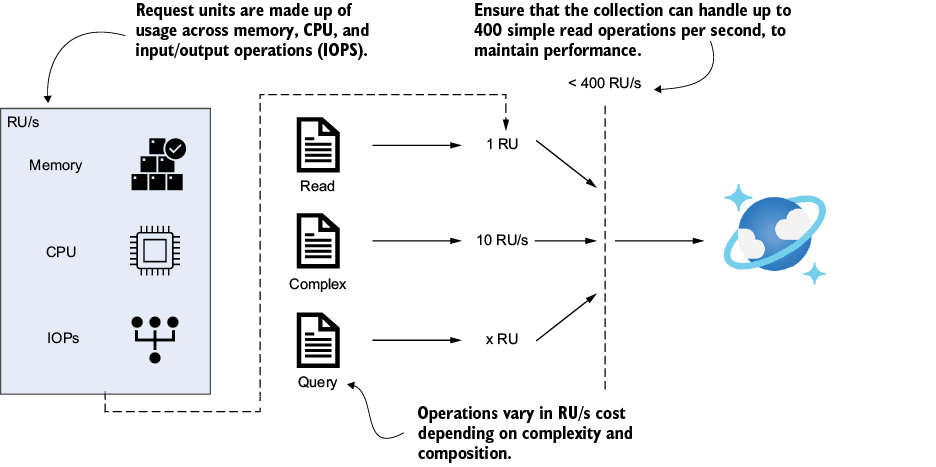
A figure connecting request units with Cosmos DB throughput and performance. section 11.1



















