Throughput measures how much data a system processes in a given time. Express it as records per second, transactions per second, or gigabytes per hour. It answers a practical question: how much work can the system complete as data volumes grow? section 7.1 section 7.1.2
Calculate and interpret throughput with care:
- Divide the amount of processed data by elapsed processing time; for records, throughput equals records processed divided by seconds. section 7.1.2
- Distinguish throughput from latency, response time, concurrency, and bandwidth: these describe different performance constraints. section 7.1
- Do not assume a constant rate. Record size, algorithmic behavior, resource contention, network latency, disk speed, and other processes can change it. section 7.1.2
Scaling a DataFrame workload
A bootstrapping function can be measured across DataFrames of different sizes. Comparing execution time with throughput may reveal that processing does not scale at a constant rate, helping estimate future resource requirements. section 7.1.2
Figure 7.2 Dependence of the execution time (solid line) and throughput (dashed line) of the bootstrapping function on the size of the processed DataFrame
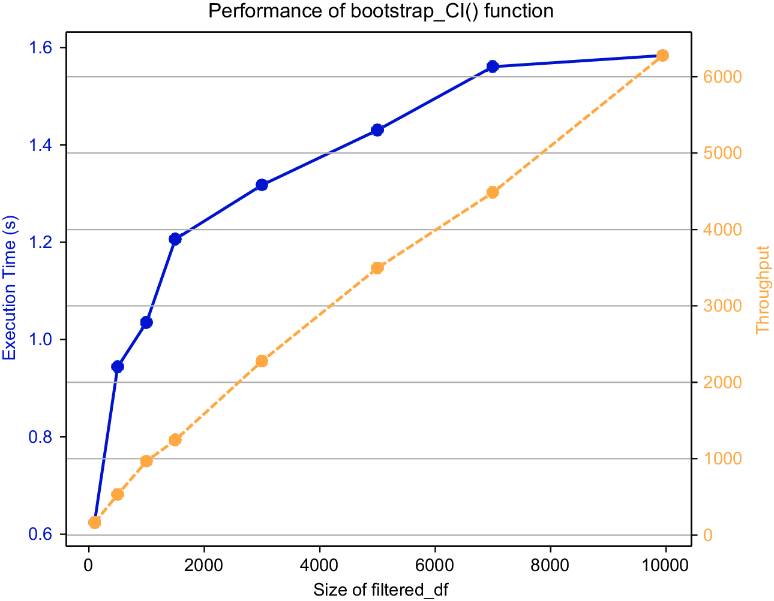
Compare the solid execution-time curve with the dashed throughput curve as the processed DataFrame grows. section 7.1.2



















