A tool gives an LLM agent an externally executable capability, such as searching the web, plotting data, or running code. The LLM requests a tool call; the application executes it and returns the result for the LLM to use in its response. section 2.0 section 1.0
A framework can standardize how tools are described and invoked:
- Define a BaseTool interface and data structures for tool-call inputs and outputs. section 2.0
- Wrap Python functions as synchronous, asynchronous, or Pydantic-backed tools. section 2.4
- Assign agents different tools for distinct responsibilities, or use tools to dispatch subagents and remote agents. section 2.4
Maintaining a project list
An agent could use web search, file reading, and a Trello tool to gather and record projects. A reusable skill specifies the procedure; the tools provide the individual operations. section 6.1.1
Figure 2.1 The focus of the current chapter, through the lens of our build plan introduced in Chapter 1. Before we can build an LLM agent, we first need to properly define tools and how they can be used within our framework.
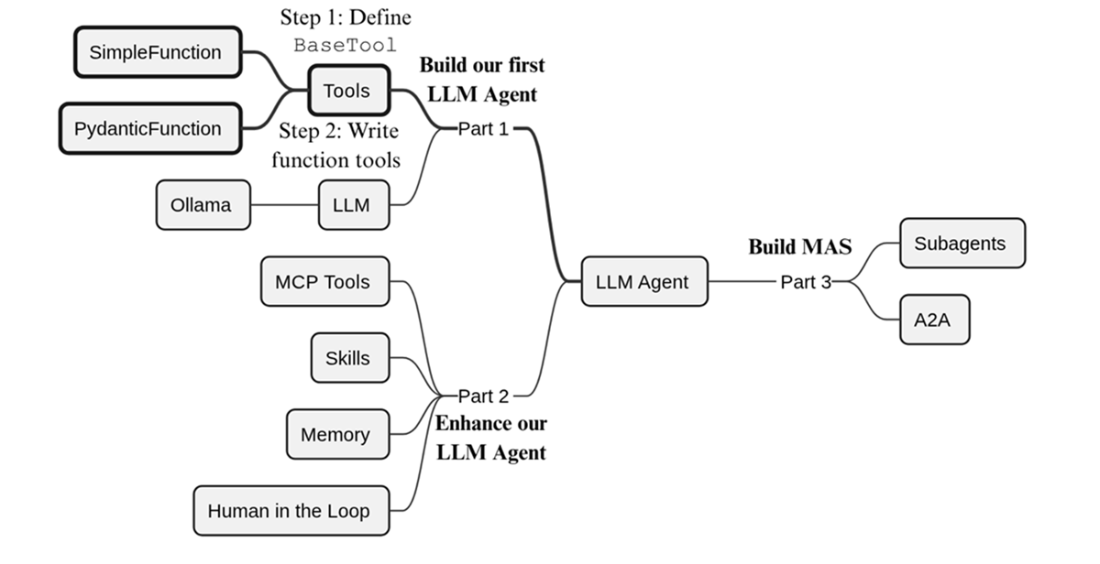
Shows tool infrastructure as a step toward building an LLM agent. section 2.0