Would you keep using a service if you did not trust the company behind it? Many people do. Phones, online accounts, shopping deliveries, and connected devices can be hard to give up, even when their users worry about how personal data is handled. Trust matters here because using a service does not necessarily mean believing it will act in your interests. section 4.4.1
Trust is the belief that someone or something is reliable, honest, and effective. It can be gained, lost, and partly regained through effort. A dishonest act or repeated deception can damage both trust and privacy, but neither concern disappears simply because people continue to participate in digital life. section 5.14 section 4.2
Confidence in major institutions cannot be taken for granted. In the United States, the share of people saying they trusted the federal government to do the right thing nearly always or most of the time fell from 77% in 1964 to 36% within a decade. Trust in business leaders is also strained, even as people expect them to act responsibly. section 4.3 section 4.4
Different institutions face different tests of trust:
- Technology companies collect or generate data through everyday products and services. People may distrust their handling of that data while feeling they have few practical alternatives. section 4.4.1
- Media companies can erode trust when opinion and reporting blur or when choices about which content to display serve revenue rather than objective reporting. section 4.2 section 4.4.3
- Governments influence trust both through their own conduct and through the rules they make for organizations that use personal data. section 4.3 section 4.10
Connected, but unconvinced
Consider a household with a phone, a child’s school tablet, social media accounts, deliveries ordered online, and a voice-controlled speaker. These services are woven into daily routines. The person using them may still object to targeted advertising, worry about a child’s recommended videos, and doubt that the companies respect privacy. Convenience and dependence are not the same as confidence. section 4.4.1
Figure 4.5 Trust in technology companies’ management of personal data18
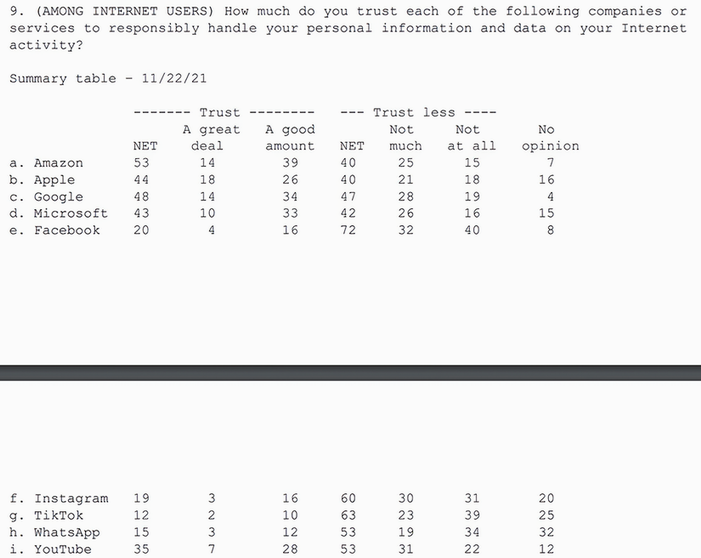
See the figure on trust in technology companies’ management of personal data when considering the gap between widespread use and confidence in the companies providing these services. section 4.4.1
Trust should be tested against actions, not reassuring messages. Ask whether an organization lets people access, change, delete, or otherwise manage their data, and whether its leaders can be held accountable for how they handle it. Rules are changing too: EU data laws and efforts in Australia and the United States are shaping what companies must do. You need not trust every institution equally to make informed choices or support better protections. section 4.4.1 section 4.4 section 4.10













