A search engine may index text, images, audio, and video that do not fit a predefined database schema. Calling this information “unstructured” is useful shorthand, but it can be misleading. Sentences have grammar and punctuation; images arrange colors into pictures; audio can carry words, music, and tone. The challenge is not an absence of structure, but extracting meaning from flexible forms. section 2.1 section 2.1.1
A SQL join links rows through an explicit shared value, such as a company ID. Search documents can also contain shared values, but their relationships are usually embedded in their content rather than declared as keys. A repeated event name, for example, can connect two separately indexed documents. Different phrases may also refer to the same entity, allowing a less exact connection through entity resolution. section 2.1.2 section 2.1.3
Finding a connection across documents
Suppose one search document says someone will speak at a conference and another describes that conference. Their shared conference name acts much like a join value. If two documents instead use a full name and a first name for the same person, connecting them requires resolving those different phrases to the same entity. A matching name alone can also be ambiguous: different people may share its spelling. section 2.1.3
Figure 2.5 Fuzzy foreign keys. In this example, the same entity is being referenced using different terms, and a join is occurring based upon multiple phrases resolving to the same entity.
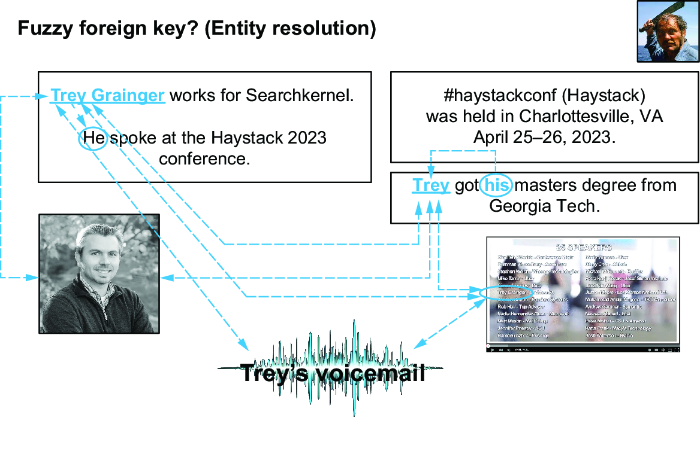
The diagram shows a fuzzy connection: separate phrases refer to the same entity, so an exact shared term is not required. section 2.1.3
Event logs show how the categories can overlap: a structured date and event type may accompany a free-text message, making the record semi-structured. Across a search collection, connections among terms, entities, and documents can form a rich graph of domain knowledge. Those connections help search move beyond exact keyword occurrence, but ambiguous language makes context important. section 2.1.1 section 2.1.3 section 2.7










