Unstructured data contains varied modalities, file types, and information that do not fit a consistent rows-and-columns model. Common examples include images, video, audio, text, sensor data in JSON, and social media streams. section 1.1 section 1.4
A predictive workflow traditionally converted unstructured inputs into structured features through feature engineering. Deep learning can instead learn the necessary transformations end to end, from the original input to a prediction. section 1.4
Use the distinction from tabular data to guide modeling choices:
- Expect unstructured data to arrive as different files or instances containing information in an unordered form rather than as a matrix. section 1.4
- Recognize that structured data is broader than tabular data: nested JSON, relational, time-series, graph, and spatial data may have structure without sharing one rows-and-columns format. section 1.1
- Choose deep learning when the problem benefits from learning representations directly from modalities such as images, audio, video, or text. section 1.4
Figure 1.1 An example of tabular data
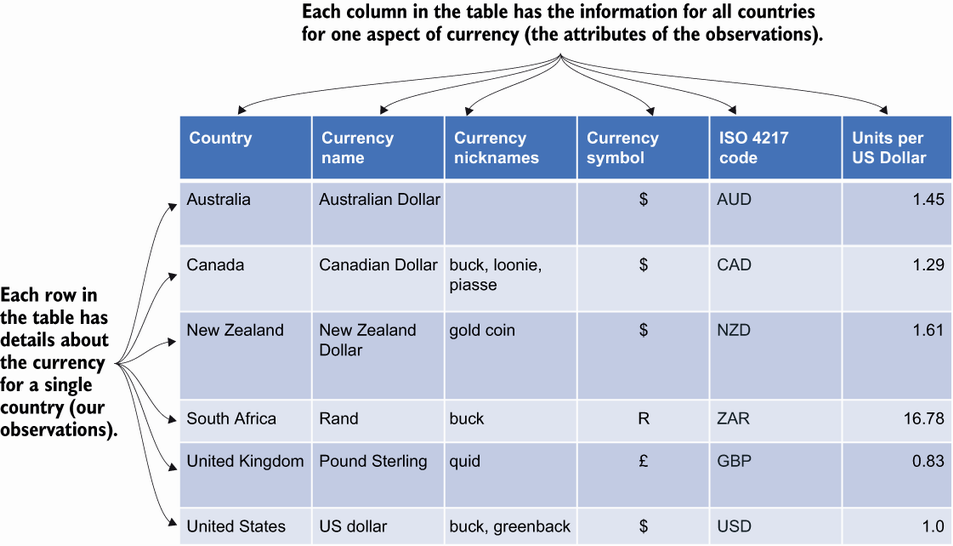
Use the tabular-data figure as a visual contrast for identifying when inputs do not conform to a regular rows-and-columns layout. section 1.1










