Unstructured data lacks a rigid predefined schema and commonly appears as article text, documents, transcripts, images, audio, or video. It preserves rich context and nuance but does not directly support precise filtering, counting, sorting, or aggregation. section 1.4 section 1.0
In retrieval-augmented generation, unstructured data supports open-ended or fuzzy questions. Text embeddings retrieve semantically similar chunks, but retrieval can mix content from unrelated documents when several contain overlapping terms. section 1.4 section 6.1
Unstructured data becomes difficult to use when a task requires:
- Selecting information from one specific document among many similar documents. section 6.1
- Filtering records by attributes such as status or organization. section 6.1
- Counting, sorting, or aggregating entities and relationships. section 1.4
A practical workflow uses LLMs to extract structured information from raw text, model entities and relationships in a knowledge graph, and import the result into a graph database. This preserves textual context while enabling precise queries. section 6.0 section 1.4
Contract retrieval
A question about ACME Inc.'s payment terms may retrieve chunks from several contracts because they share words such as “payment” and “terms.” Structuring contract identity, status, and terms enables document-specific retrieval and questions such as counting active ACME contracts. section 6.1
Figure 1.14 A knowledge graph can store complex structured and unstructured data in a single database system.
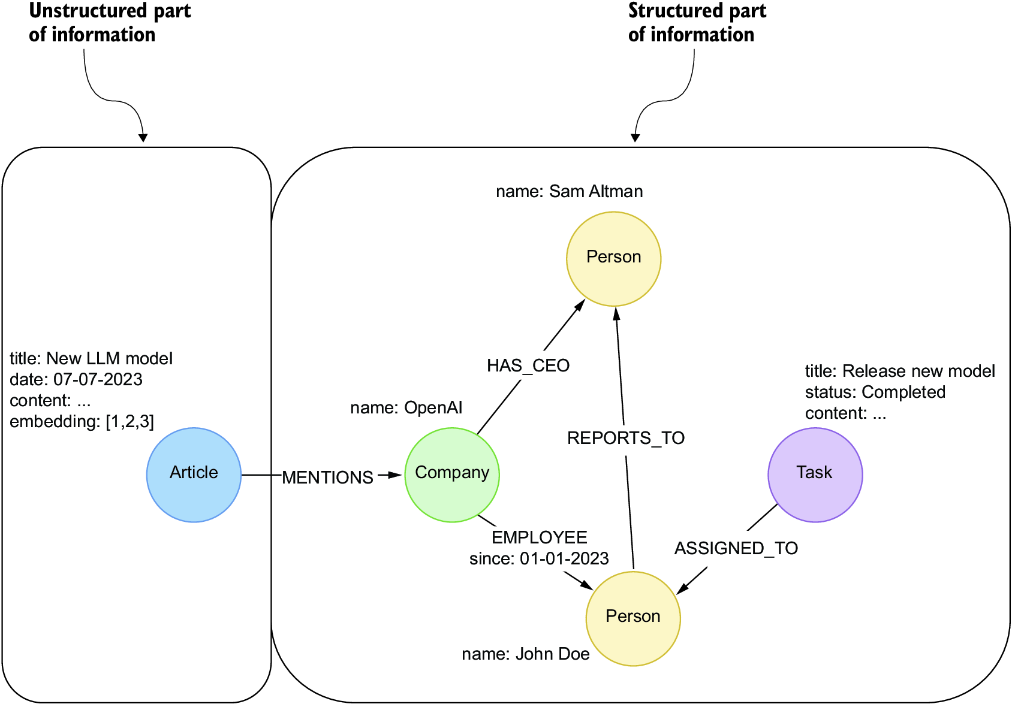
Shows how one knowledge graph can store structured records alongside unstructured article content. section 1.4










