Unstructured data is information without a fixed tabular or schema-constrained organization, including emails, chats, laws, research papers, news, social media, and free-form reports. Turning it into usable knowledge requires ingestion, processing, NLP, enrichment, machine learning, and data modeling. section 5.0 section 7.5.1
Account for the main engineering difficulties:
- Handle multiple languages, scripts, encodings, typos, pronoun references, varied writing styles, and domain-specific terminology. section 1.1
- Extract entities and relationships before mapping isolated information into a connected knowledge graph. section 5.0 section 1.5.3
Healthcare and drug discovery
Process regulatory reports, clinical documents, scientific publications, and databases to connect diseases, genes, drugs, and other biological entities. Validate integrity, accuracy, consistency, and context before using the resulting knowledge for retrieval or hypothesis generation. section 1.5.1 section 7.5
Figure 1.1 Example KG in the healthcare domain. Nodes (circles) represent entities, such as people, diseases, and anatomic parts. Edges (relationships) represent meaningful connections among entities. Nodes and edges have properties describing relevant details.
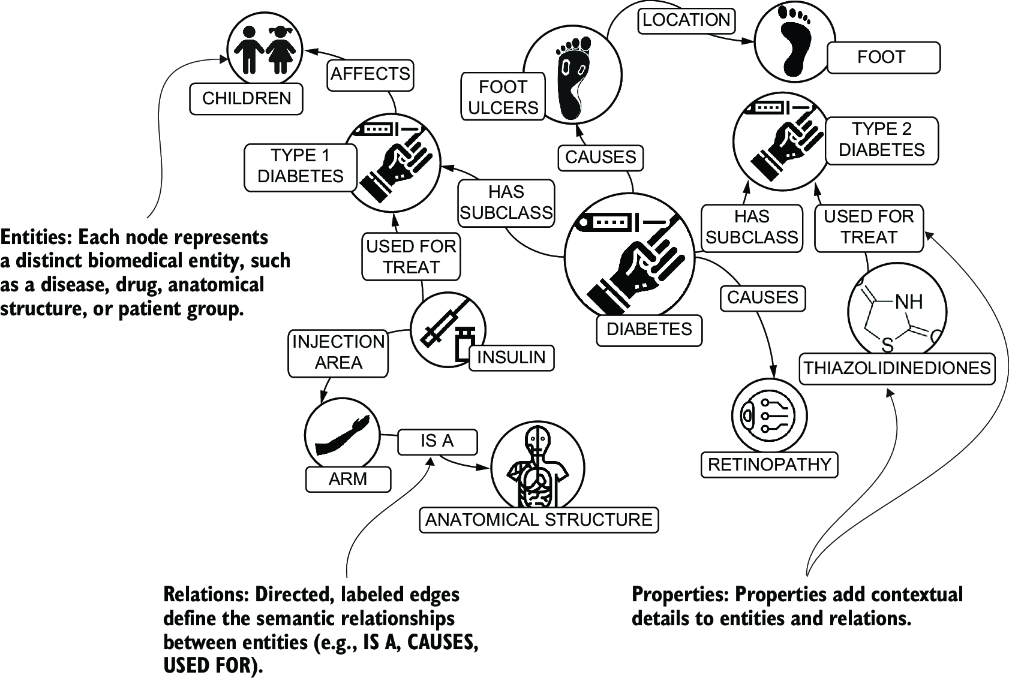
Use the healthcare knowledge-graph diagram to see how extracted entities become nodes and meaningful connections become typed, property-bearing edges. section 1.1










