Unstructured data includes text, images, and audio that do not arrive as ordinary tabular features. In an online marketplace, item images, descriptions, and reviews may complement sales and click histories. A common bridge is to extract embeddings with pretrained neural networks and use those embeddings as features. section 11.4.1
Use unstructured data deliberately in the ML system:
- Treat pure deep-learning workloads with one or two unstructured sources as less natural candidates for a feature store than tabular workloads. section 11.4.1
- Store extracted embeddings when shared access, processing savings, or training-serving consistency justify centralization. section 11.4.1
- Monitor derived signals rather than relying on simple tabular range checks: use image brightness or color temperature, text length, and audio-frequency distributions. section 14.3.6
- Validate inputs and outputs at each pipeline stage so corrupted transformations can be located without retracing the entire workflow. section 14.3.6
Marketplace recommendations
A recommendation system can combine sales and click histories with image, description, and review embeddings. A vector database can retrieve similar items quickly for downstream models, while monitoring checks detect unusual image, text, or audio-derived statistics. section 11.4.1 section 14.3.6
Figure 11.12 A landscape of ML problems with various needs for a feature store
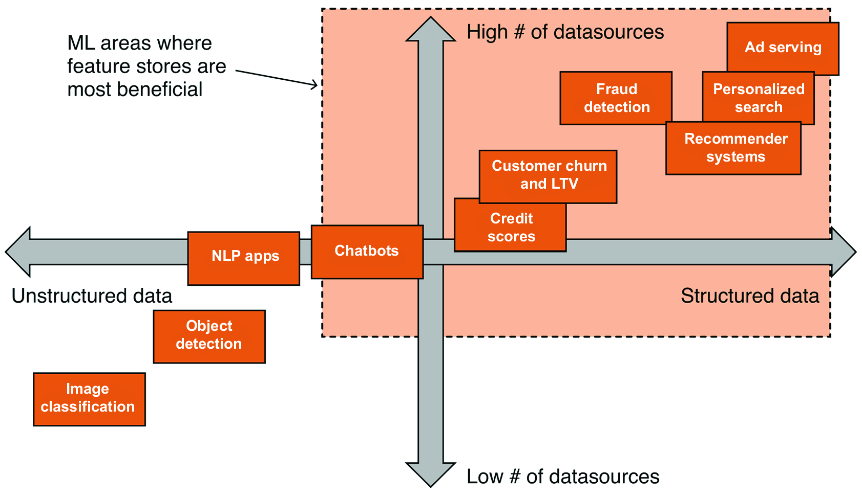
Use the landscape to compare how different ML problem types benefit from centralized feature storage. section 11.4.1










