Version control records successive changes to files so teams can review, approve, attribute, audit, and, when necessary, roll back them. For authorization, it turns access rules into visible software artifacts rather than scattered application checks. section 14.2 section 4.4.2
A governed version-control workflow for policies provides:
- A complete change history with author attribution and review comments. section 14.2
- Peer approval before policies or access rules are merged. section 14.7
- Traceability from policy changes to ownership, rationale, and governance evidence. section 14.2 section 14.7
- A repeatable path into validation, testing, deployment, and runtime authorization. section 10.2.4
Restricting Team Reports
Carol commits a declarative policy allowing Project Managers to view Team Reports only during working hours. A teammate reviews it, known scenarios test it, and the approved policy is deployed for the PDP to evaluate. section 4.4.2
Figure 10.6 Continuous integration for policies. Bob’s pull request triggers validation, analysis, and testing. After the checks pass, his changes are merged, bundled into a signed package, and published to a policy store, where the authorizer uses them to evaluate requests at runtime.
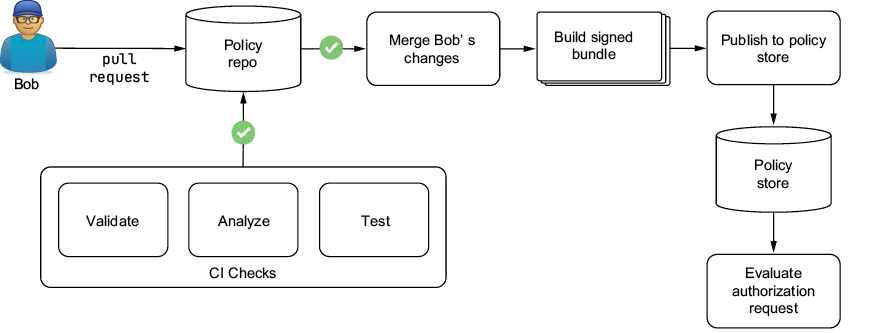
The workflow shows a pull request triggering validation, static analysis, and tests before reviewed policies are bundled, signed, published, and used at runtime. section 10.2.4
























