liveBook · Manning

Versioning

As explained in Road to Kubernetes

Version control is a system for recording, managing, and coordinating changes to files and source code over time.

Version control records changes to files over time so you can return to earlier states. Like undo and redo, it lets you move backward or forward through a document’s history. Git is a version control system used to track and share code. section 2.3

With Git, you can:

  • Track code changes and ignore selected file types. section 2.3
  • Revert code to an earlier version. section 2.3
  • Push code to remote storage and pull it for production. section 2.3
  • Trigger workflows that use the code, including CI/CD automation. section 2.3

In a deployment workflow, Git tracks and shares application code before containers are introduced; changes in Git can also trigger automated builds. section 1.2

Figure 1.2 Code path to Kubernetes
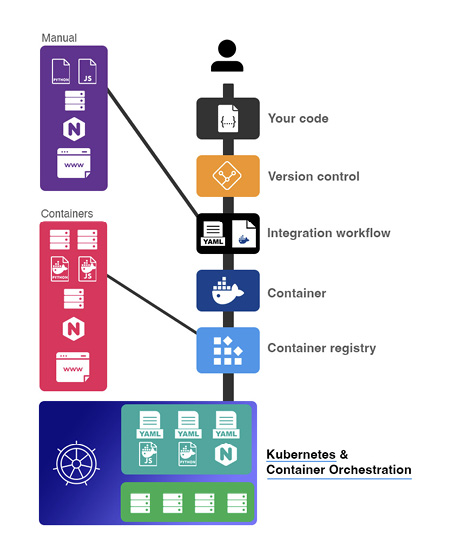
Shows where tracking and sharing code fit in the path toward deployment automation and Kubernetes. section 1.2


How Road to Kubernetes covers it

How deep it goes
Defines version control through an undo analogy and lists Git capabilities, without detailing their internal mechanics.
Examples
Uses notebook copies and undo/redo as analogies, then illustrates Git with code tracking and reversion.
What it assumes
Assumes at least beginner familiarity with coding modern applications.
What you can do after
Apply version control via Git to track, revert, share, and retrieve code, and trigger workflows.
How it connects
Connects Git with remote repositories, CI/CD, and deployment.

Also explained in

Compare how 25 books explain versioning →

Related concepts

This explainer was generated by Manning's knowledge graph from the text of Road to Kubernetes. The section links point to the parts of the book it draws on.






















