Version control records and manages successive changes to DSL content, enabling collaboration, release management, auditing, and regulatory compliance. section 10.1
Distributed version control systems organize change through:
- Commits, which represent the state of code at a point in time and carry an identity such as a Git SHA hash. section 10.1
- Branches, which are named sequences of commits for independent feature or bug-fixing work. section 10.1
- Tags, which associate a string with a particular commit to identify a version. section 10.1
- A collaborative workflow that branches from a mainline, shares committed changes, reviews completed work, and merges it back. section 10.1
Managing changing DSL content
A team can place DSL content under Git version control, develop changes on feature or bug-fixing branches, review them, and merge approved work into the mainline. section 10.1
Figure 10.2 The main concepts of a DVCS, and a typical interaction
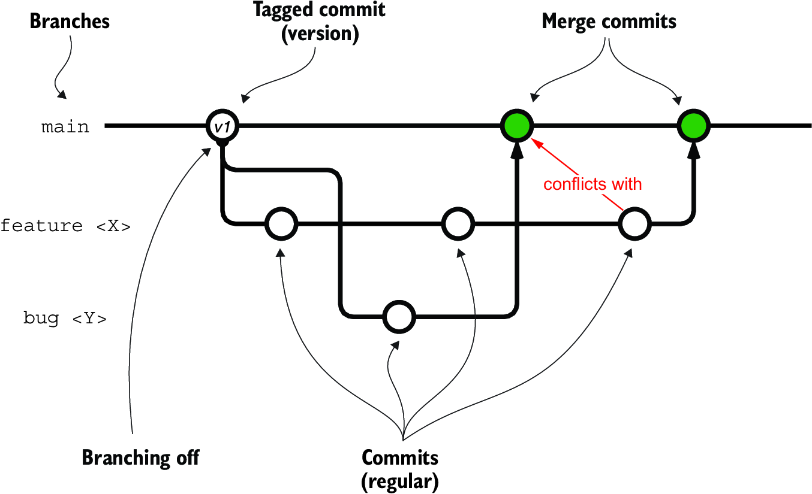
Use the diagram to navigate the relationships among commits, branches, tags, and typical distributed workflows. section 10.1
























