liveBook · Manning

Parallelism

As explained in Effective Data Analysis

Parallel processing is the simultaneous execution of separate portions of a computational task.

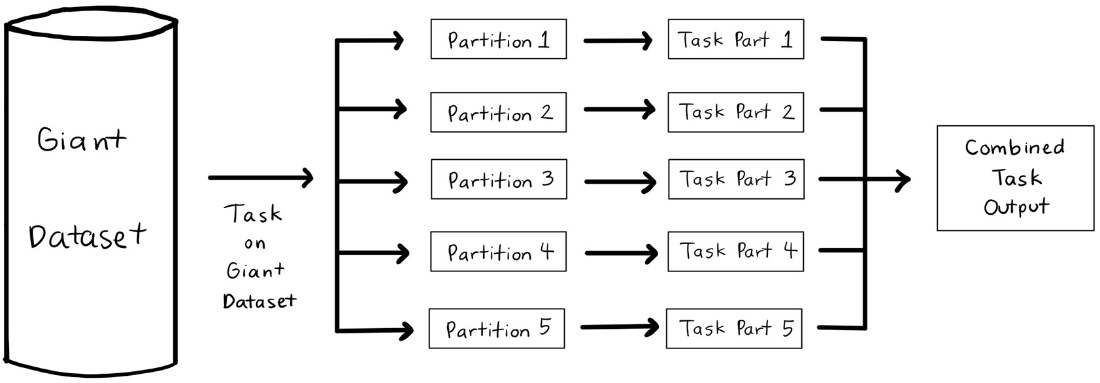
Parallel processing executes separate portions of a computational task simultaneously. Distributed computing frameworks divide massive datasets into manageable tasks, process them across cluster nodes, and recombine the results, reducing runtime compared with a single machine. section 11.2.3

Working with parallel processing may require analysts to:

  • Use a distributed framework’s SQL dialect, such as Spark SQL, when querying data. section 11.2.3
  • Adopt distributed data-wrangling and modeling libraries, such as PySpark, instead of local tools. section 11.2.3
  • Manage resource limits, node counts, query sizes, and processing costs. section 11.2.3
Figure 11.10 Parallel processing divides a data processing task into manageable chunks and recombines it into the final output.
figure

Shows how parallel processing divides a data task into manageable chunks and recombines them into a final output. section 11.2.3


How Effective Data Analysis covers it

How deep it goes
Explains task division, cluster execution, result recombination, and fault tolerance, but stops short of implementation details.
Examples
Uses Spark SQL, PySpark, and a task-partitioning figure as concrete examples of parallel data processing.
What you can do after
Apply it via distributed computing frameworks while accounting for framework syntax, resource limits, and processing costs.
How it connects
Links distributed computing with clusters, data warehouses, SQL, statistical modeling, and machine learning.

Also explained in

Compare how 38 books explain parallelism →

Related concepts

This explainer was generated by Manning's knowledge graph from the text of Effective Data Analysis. The section links point to the parts of the book it draws on.



































