liveBook · Manning

Parallelism

As explained in Introduction to Generative AI, Second Edition

Parallelization is the execution of independent subtasks or tool calls concurrently rather than sequentially.

Parallelization runs independent subtasks or tool calls at the same time instead of waiting for each sequentially. In agent architectures, planning can expose these opportunities and reduce delays on complex, multistep work. It cannot replace dependencies: when one call needs another’s result, those actions must remain ordered. section 8.12

A website with recent pickleball news

An agent can generate a website’s basic frontend while researching documentation for a news API. After selecting and calling the API, it can populate the site with retrieved stories and complete dependent details. section 8.12
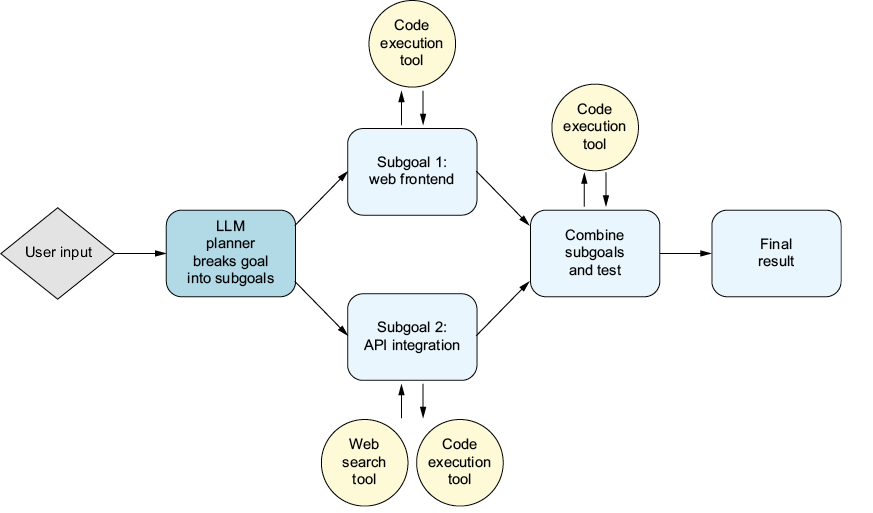
Figure 8.8 A sample execution flow for a task with planning and parallelization
A diagram of a diagram

AI-generated content may be incorrect.

The execution-flow diagram shows how planning divides a larger task, runs independent actions together, and sequences dependent follow-up work. section 8.12


How Introduction to Generative AI, Second Edition covers it

How deep it goes
Explains the principle and task dependencies through a workflow example, but does not detail implementation mechanics.
Examples
Uses a pickleball news website whose frontend work and API research proceed in parallel.
What it assumes
Assumes familiarity with multistep agent tasks and tool calls while clarifying independence and dependency from examples.
What you can do after
Apply it by separating independent subtasks from actions whose inputs depend on earlier results.
How it connects
Connects parallelization with agent architectures, planning, tool calls, reflection, and code generation.

Also explained in

Compare how 38 books explain parallelism →

Related concepts

This explainer was generated by Manning's knowledge graph from the text of Introduction to Generative AI, Second Edition. The section links point to the parts of the book it draws on.



































