Autonomy is delegated decision-making power: a system evaluates context at runtime and selects actions toward a goal within defined boundaries. Unlike deterministic automation, which executes decisions encoded in advance, an autonomous system can choose different actions as data, timing, and feedback change. Its overall behavior cannot be fully predicted in advance. section 1.2.1 section 2.1.1
Fraud containment at 3 a.m.
A bank’s fraud agent bypasses a human alert queue and freezes thousands of accounts through a ledger API. It prevents losses, but customers lose access to money. The API credentials enabled action; they did not establish a documented authority chain, decision boundaries, or an accountability trail. A safer mandate could permit freezes up to a specified number of customers and require human sign-off above that limit. section 1.1 section 1.5.1
Figure 1.1 Deterministic and agentic fraud response flows, showing the shift from human approval to delegated system authority and the move from hours-long governance cycles to autonomous action in seconds.
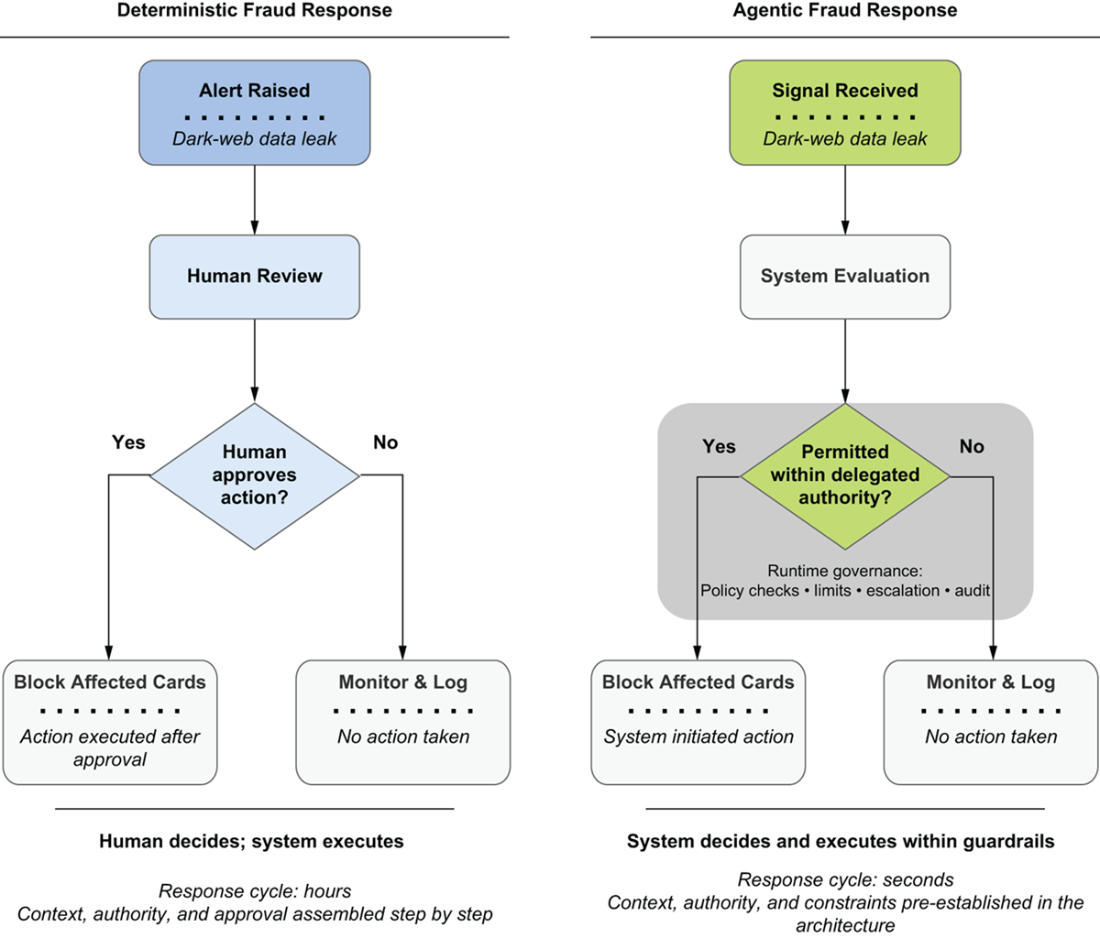
Compare the human approval point in a deterministic fraud response with delegated authority in an agentic response. section 1.1
Agentic behavior is defined by the ability to perceive context, choose actions, and adapt within boundaries—not by a particular model. An agent may use a rules engine, an optimization model, or machine learning; generative AI can be a reasoning component without being the agent itself. section 1.2.3
Design delegated autonomy as an operating mandate, not merely as technical access:
- Bound it: state which decisions are permitted, where authority ends, and when the system must escalate. section 2.1.1 section 1.5.1
- Attribute it: identify who authorizes the delegation, owns its business purpose, may change its limits, and is accountable for consequences. section 2.1.2
- Observe it: track the decisions made, their position relative to limits, and changes in behavior—not just latency and errors. section 2.1.3
- Keep it governable: enforce policy while the system is live, with effective ways to constrain, redirect, pause, or escalate action. section 2.1.4 section 1.2.2
Guardrails are architectural controls, rather than instructions the agent is trusted to follow. They can include authorization checks, rate limits, confidence thresholds, and kill switches. A policy gateway can evaluate proposed actions before execution; if its policy engine is unavailable, it can fail closed or route the action to human review. Decision logs can record the action, policy, and outcome for audit. section 1.2.2 section 1.7 section 1.3
Governance continues after deployment. Observing an agent near the edge of its permitted space is useful only if the enterprise can change its operating conditions or intervene. Establish shared controls, ownership, observability, and escalation early rather than retrofitting them across isolated deployments. section 2.1.4 section 1.6













