liveBook · Manning

Autonomy

As explained in Build High Value Software Systems

Control over how one works and the ability to exercise judgment in defining and solving problems.

In software work, autonomy means defining the problem and letting the team decide how to solve it. It gives developers room to exercise judgment instead of merely implementing a prescribed solution. section 13.3

Problem or prescribed solution?

“Users need to filter by any date range” leaves room to explore solutions. “Add a dropdown with three preset options” dictates one. With autonomy, a developer can ask AI to explore flexible date-filtering patterns, then judge which solution serves users. section 13.3

Figure 13.4 Autonomy, mastery, and purpose as drivers of self-sustaining Lean culture.
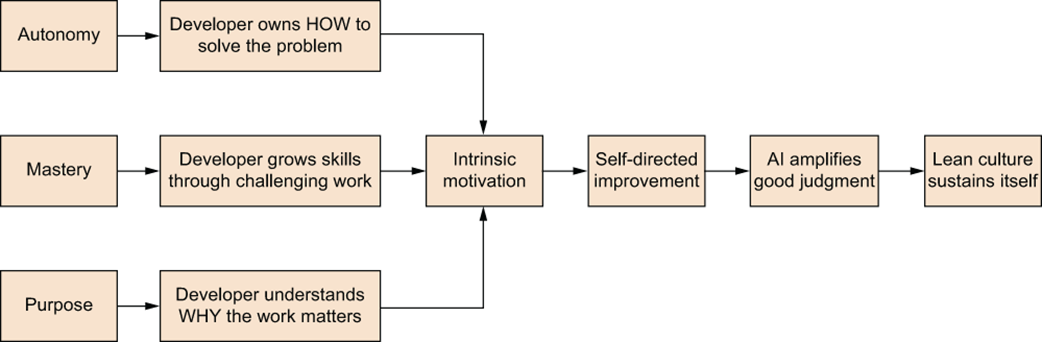
See autonomy alongside mastery and purpose as drivers of a self-sustaining Lean culture. section 13.3


How Build High Value Software Systems covers it

How deep it goes
Defines autonomy through problem ownership and contrasts open-ended problem statements with externally prescribed solutions.
Examples
Uses flexible date filtering to contrast a user problem with a three-option dropdown specification and corresponding AI prompts.
What you can do after
Evaluate AI-generated solutions critically by framing the user problem before specifying an implementation.
How it connects
Connects autonomy with mastery, purpose, intrinsic motivation, Lean, and AI-assisted software development.

Also explained in

Compare how 14 books explain autonomy →

Related concepts

This explainer was generated by Manning's knowledge graph from the text of Build High Value Software Systems. The section links point to the parts of the book it draws on.











