A bounding box is an axis-aligned rectangle that describes an object’s location and extent within an image. Its four parameters are the top-left coordinate (x_tl, y_tl) and bottom-right coordinate (x_br, y_br). Image classification identifies object categories; object detection adds these coordinates to localize each detected object. section 11.0
In a region-based detector, bounding-box coordinates serve several connected purposes:
- The region proposal network emits candidate regions of interest, while the Fast R-CNN head predicts class probabilities and four coordinate values for each class. section 11.4 section 11.4.3
- A proposal such as (0, 0, 256, 256) maps to (0, 0, 16, 16) on a feature map with a subsampling factor of 16. section 11.4.3
- The detector learns regression targets for box adjustments and selects the coordinate offsets associated with the predicted object class during inference. section 11.4.3
From image region to detector output
Suppose an RoI covers pixels from (0, 0) to (256, 256). The convolutional backbone represents that area by the corresponding (0, 0)–(16, 16) feature-map region. RoI pooling extracts a fixed-size representation, after which the detector produces class scores and four localization values for the relevant class. section 11.4.3
Figure 11.12 architecture. (Source: “Faster R-CNN: Toward real-time proposal networks”; https://arxiv.org/abs/1506.01497.)
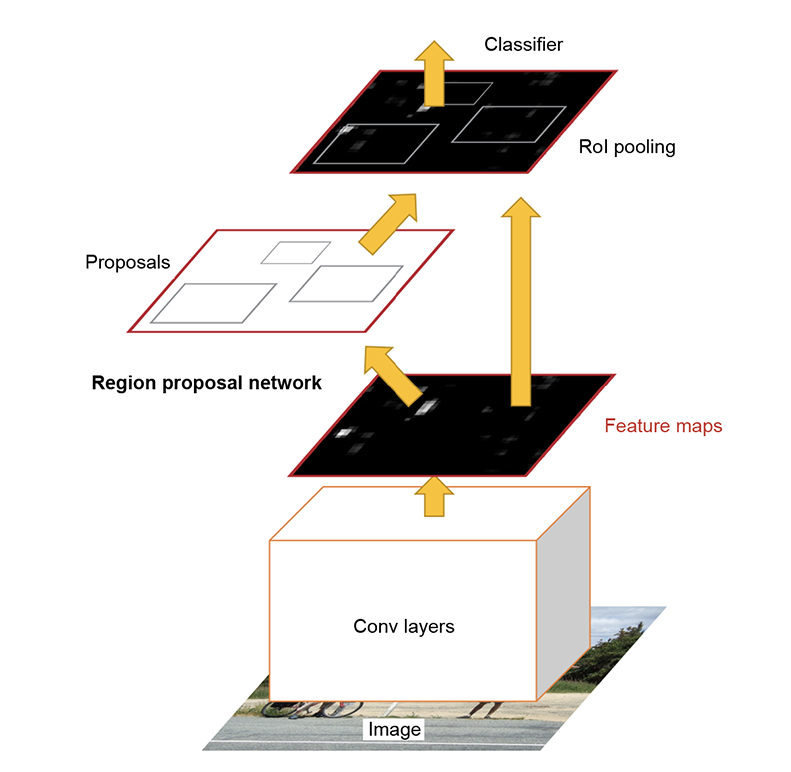
Trace bounding boxes through the Faster R-CNN architecture, from convolutional feature maps and region proposals to classification and coordinate prediction. section 11.4







