A label is a target annotation or observed outcome attached to a data example. It lets an evaluation compare a model prediction with a reference and calculate performance. section 2.2.1 section 2.2
Labels can represent ground-truth categories or behavioral outcomes. Historical interactions such as clicks, watches, ratings, purchases, and saves are useful signals, but they may be proxies rather than perfect measures of preference. section 2.2.1
Labels support several evaluation tasks:
- Compare classification predictions with binary or multi-class ground-truth labels to measure accuracy. section 2.2.1 section 2.2
- Supply reference outcomes for metrics such as precision, recall, or AUC in an offline evaluation. section 2.2
- Enable deterministic checks when the expected classification label is known, avoiding a less reliable model-based judge. section 9.9
Movie recommendation
A recommendation evaluation can compare predicted items with recorded clicks, watches, ratings, or purchases. These outcomes provide labels or proxy labels, but prominent placement may influence a click, so the resulting metric needs careful interpretation. section 2.2.1
Figure 2.3 illustrates the input-output framework for offline evaluations. The process begins with data as the input, including historical interactions, ground truth labels, and contextual metadata. Through the design phase, which involves selecting metrics and structuring evaluation scenarios, the evaluation produces metrics and insights as the output, such as precision, recall, bias detection, and robustness analysis.
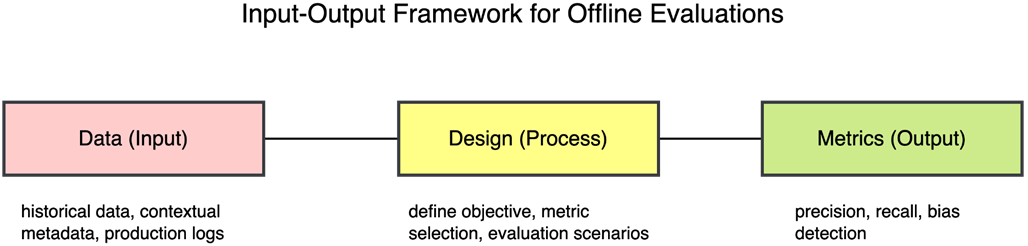
The offline-evaluation framework places ground-truth labels alongside historical interactions and metadata as input, then connects them to metrics and diagnostic outputs. section 2.2