Code generation produces API-client DTOs from an interface definition. It is common for binary message payloads; for text-based payloads, clients can instead use generated, handwritten, or untyped models. section 8.1.7
Choose an implementation strategy by weighing:
- Development effort, including initial creation and maintenance as the API evolves. section 8.1.7
- Schema correctness, compile-time type safety, and design-time coupling to fields the client uses. section 8.1.7
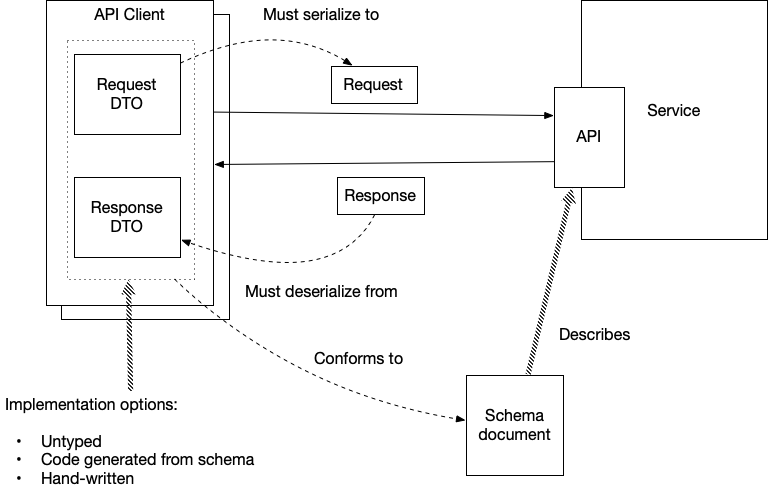
Figure 8.3 An API client must have a data model of the messages that it exchanges with the service. The data model must serialize and deserialize correctly as defined by the schema. It can either be untyped (e.g. hash maps) or consist of handwritten or code-generated classes.
Compare untyped, handwritten, and generated message models and their role in schema-aligned serialization and deserialization. section 8.1.7




















