A confusion matrix tabulates correct and incorrect predictions for each class, making model behavior more specific than overall precision, recall, or F1-score. It is especially useful when errors affect classes differently, such as licit versus illicit nodes or predicted user–movie links. section 12.1.5 section 12.2.5
Read the matrix by separating:
- Correct predictions for each class, including true positives and true negatives. section 12.2.5
- Incorrect predictions, including false positives and false negatives. section 12.1.5 section 12.2.5
- Class-specific trade-offs: missing illicit nodes differs operationally from incorrectly flagging licit nodes, just as missed ratings differ from irrelevant recommendations. section 12.1.5 section 12.2.5
Comparing GNN link predictors
For user–movie link prediction, SAGE records 19,084 true negatives, 7,211 true positives, 2,872 false negatives, and 1,082 false positives. The matrix shows strong filtering of unlikely movies, but also reveals missed potential ratings. section 12.2.5
Figure 12.6 Confusion matrices to understand the performance of GCN, GAT, and SAGE models on each class (licit or illicit)
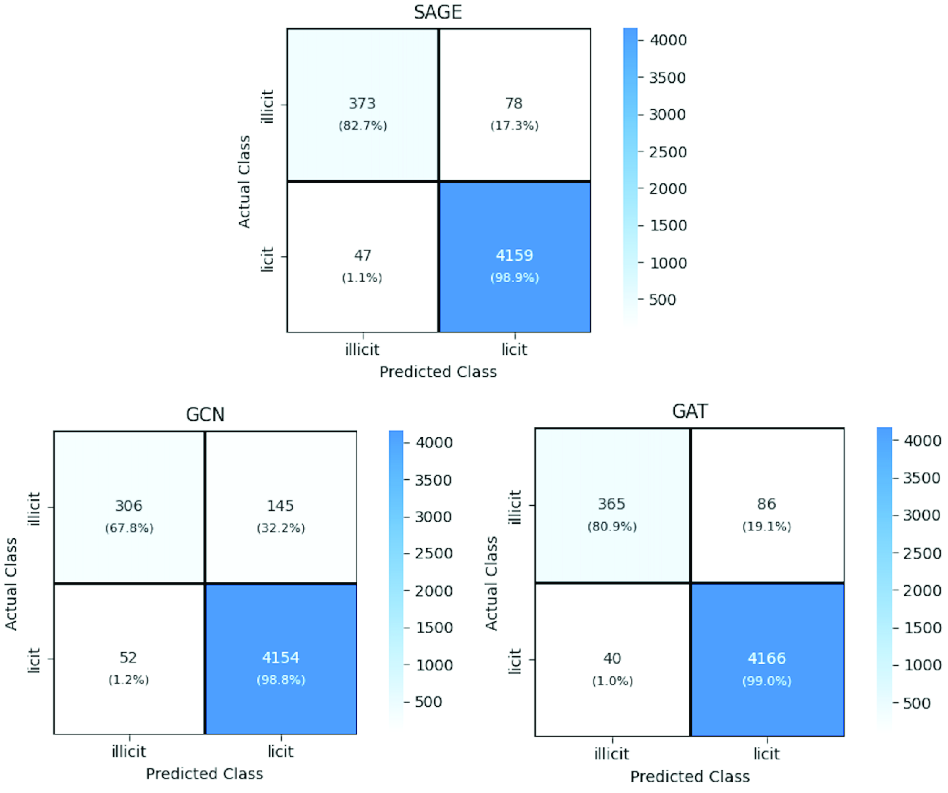
Compare class-level confusion matrices for GCN, GAT, and SAGE on licit and illicit node classification. section 12.1.5
Figure 12.11 Confusion matrices of GCN, GAT, and SAGE models on the testing dataset
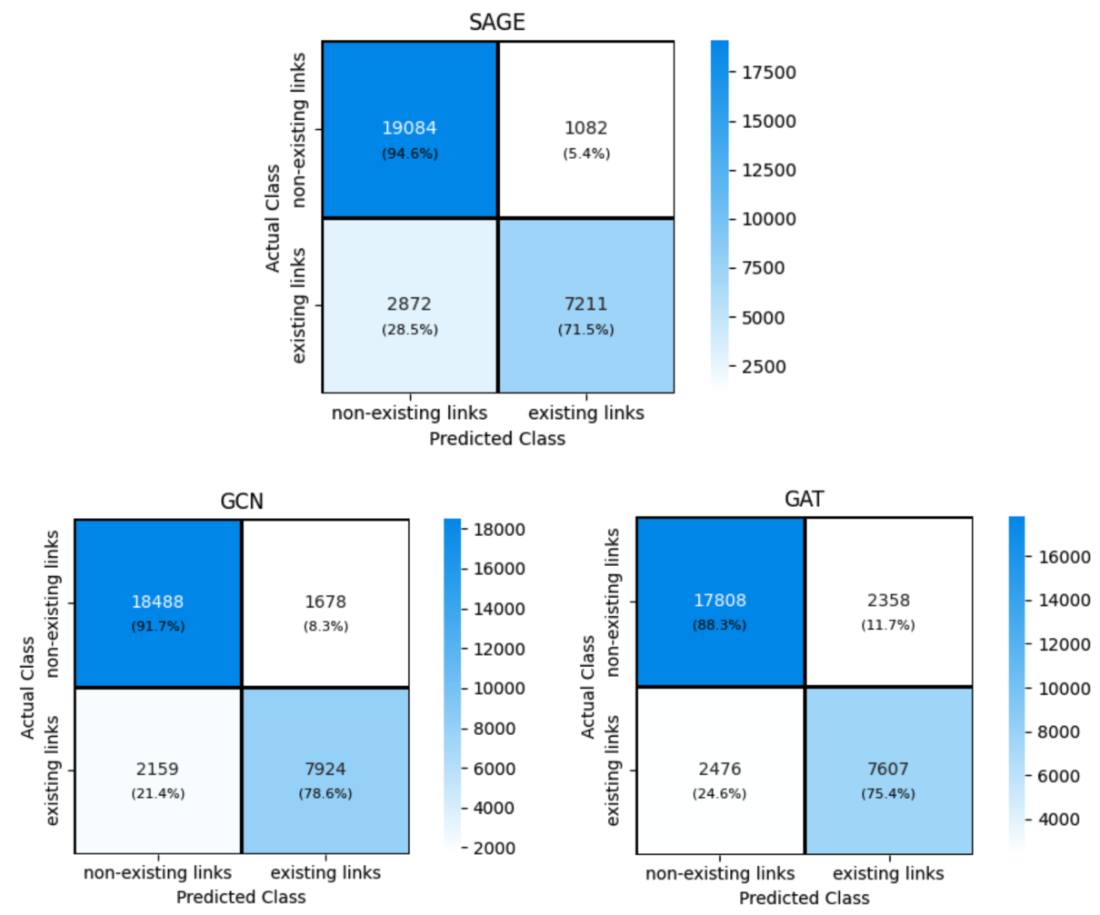
Inspect testing-dataset confusion matrices for GCN, GAT, and SAGE link prediction. section 12.2.5













