A convolutional neural network (CNN) processes grid-like data, especially images, by learning localized patterns. It is commonly used for computer-vision tasks such as image segmentation and classification. section 3.4.1
A typical CNN layer follows a short transformation pipeline:
- Filter or kernel: applies learnable weights that highlight particular features in the input. section 3.4.1
- Activation function: applies a nonlinear transformation to the filter output. section 3.4.1
- Pooling: reduces the output size, producing a more manageable representation for later learning. section 3.4.1
Convolution builds hierarchies of localized patterns. A CNN slides a learned kernel across a fixed pixel grid, whereas a graph convolutional network applies convolution to graph structure to identify node or graph patterns. section 3.4.1
This distinction reflects different inductive biases: CNNs exploit the ordered spatial structure of images, while graph neural networks are designed for permutation-invariant relational data. section 1.2.4
Figure 3.11 A convolution of an input image (left). The kernel (middle) is passed over the image of an animal, resulting in a distinct representation (right) of the input image. In a deep learning process, the parameters of the filter (the numbers in the matrix) are learned parameters.
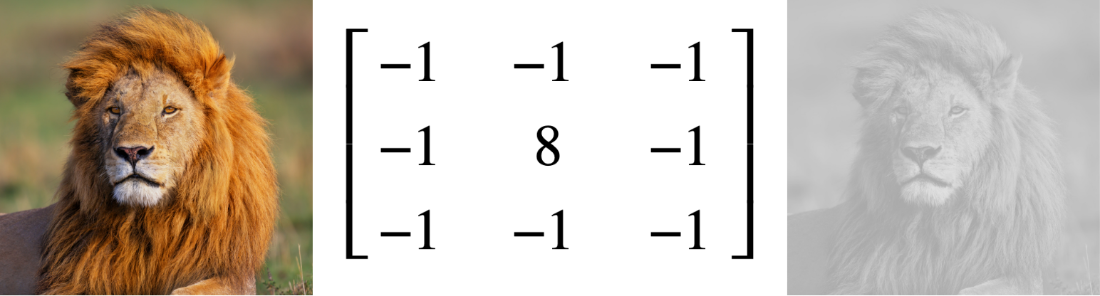
The image-and-kernel illustration shows how learned filter weights pass over an animal image to produce a distinct feature representation. section 3.4.1

















