In 2012, AlexNet made convolutional neural networks (CNNs) difficult to dismiss. Trained by Alex Krizhevsky, Ilya Sutskever, and Geoffrey Hinton to classify images, it achieved a 15% top-5 error rate in the ImageNet competition, against roughly 26% for conventional methods. Top-5 error means the correct answer is absent from a model’s five leading guesses. section 2.0
A CNN is a neural network that applies learned convolutional filters to structured input such as images. Where earlier vision systems relied on handcrafted features, AlexNet was trained end-to-end on raw images. Its success showed that a different architecture could extract more from image data—not merely that a larger dataset would improve an established approach. section 1.1 section 2.5.5
From an unlikely entrant to the default approach
AlexNet was the only artificial neural network in the 2012 ImageNet competition. In 2013, nearly every entry used a CNN. Subsequent architectures pushed error lower: GoogLeNet reached 6.7% top-5 error in 2014, and R-CNN extended CNNs to object detection. section 2.5.5
Figure 2.6 The top-5 error rates in the ILSVRC from 2010 to 2017. SIFT and SVM won in 2010 and 2011, but performance plateaued. CNNs won from 2012 to 2017, including AlexNet in 2012, and eventually saturated the benchmark.
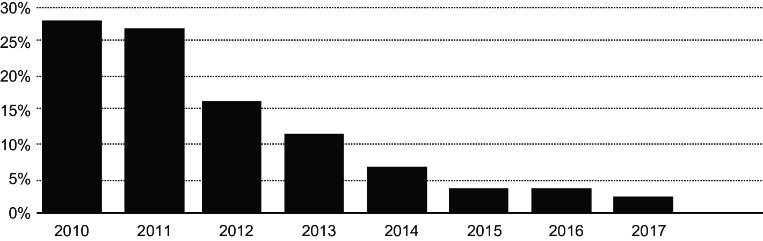
The competition results show the plateau before AlexNet, successive CNN victories, and the benchmark’s eventual saturation. section 2.5.5
Convolution also appeared in sequence models. ByteNet and ConvS2S used dilated convolutions to widen the context available to local filters, but convolutional networks still relied on fixed, local interactions. The Transformer offered a contrasting approach: self-attention rather than convolution to connect information within a sequence. A decisive architecture for image recognition was therefore not the last word on how to model context. section 5.8

















