A convolutional neural network (CNN) analyzes nearby parts of structured data with sliding, learned filters. It preserves spatial relationships instead of treating every input as an unrelated list of values, making it especially useful for images. section 9.29 section 12.13
A CNN processes an image in two especially important ways:
- Convolution examines a pixel together with neighboring pixels, using filters to detect features such as edges and other visual patterns. section 9.29
- Pooling downsamples the detected patterns by summarizing features, encoding distinctive visual signatures more concisely. section 9.29
- Successive layers can detect increasingly complex features, moving from simple edges toward objects such as faces and cars. section 12.13
Following a visual pattern
Imagine an image containing a recognizable object. A filter slides across local pixel regions and responds to useful patterns, such as edges. Pooling summarizes those responses, while later layers combine the simpler patterns into a distinctive object signature. The resulting representation can support image classification. section 9.29 section 12.13
CNNs support image classification, optical character recognition, and medical-image analysis. They can also detect local word patterns for text classification, although they are less suitable for complex long-range sentence meaning. Unlike ordinary linear feed-forward layers, convolutional layers analyze regions independently while retaining pixel positions. section 9.29 section 12.13 section 11.11
Figure 9.33 Simple example of a CNN
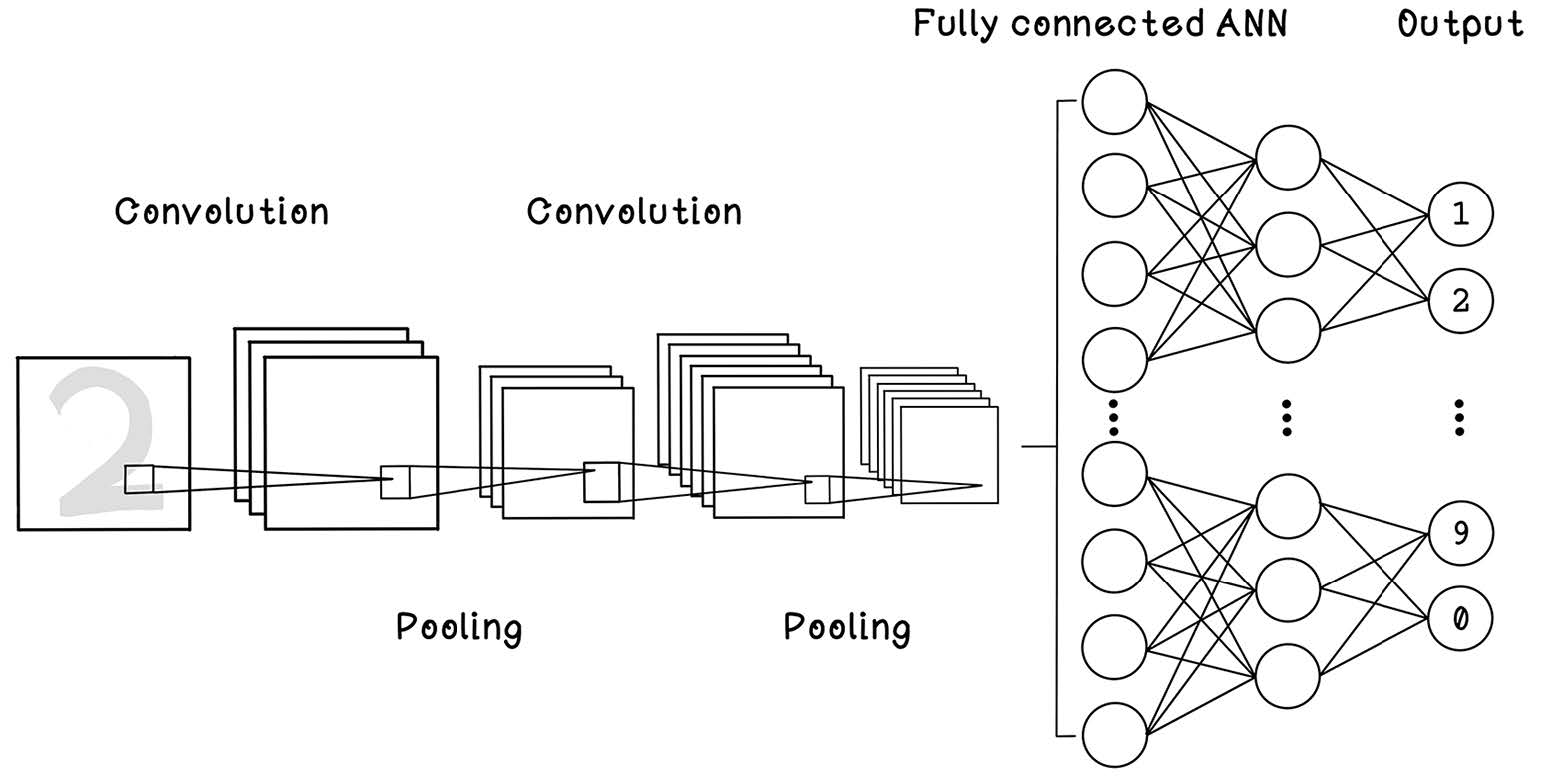
Use the diagram to trace how convolution and pooling turn image patterns into a concise learned representation. section 9.29
Figure 12.23 The difference between an ANN and a CNN
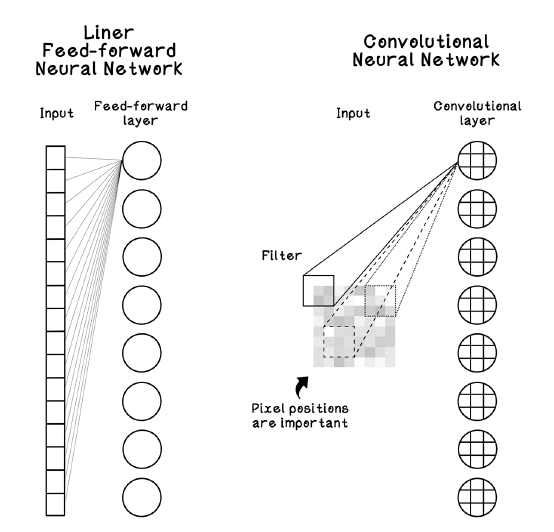
Use the comparison to see how a convolutional layer preserves spatial structure while a linear layer processes inputs uniformly. section 12.13

















