A convolutional neural network (CNN) processes structured data with trainable filters, convolution, nonlinear activation, and often pooling. For an image of width W, height H, and C channels, a kernel slides across positions, computes dot products, and forms feature maps. Shared filters reduce parameters and support translation-invariant classification. section 10.2
A typical CNN proceeds through these operations:
- Convolve input data with trainable kernels to extract features. section 10.2
- Apply nonlinear activation functions between stacked convolutional layers. section 10.2
- Down-sample feature maps with max pooling, average pooling, or global average pooling. section 10.2
- Flatten the resulting representation and pass it to dense and softmax layers for classification. section 10.2.1
LeNet for handwritten digits
A LeNet-style model classifies MNIST digits by stacking convolution, ReLU, and max-pooling stages, increasing filter counts while reducing feature-map dimensions. A final dense softmax classifier produces predictions. Keras/TensorFlow code loads and reshapes MNIST data, trains the model, evaluates test accuracy, records loss and accuracy, and uses early stopping; the reported test accuracy reaches 99%. section 10.2.1
Figure 10.4 LeNet architecture for MNIST digits classification
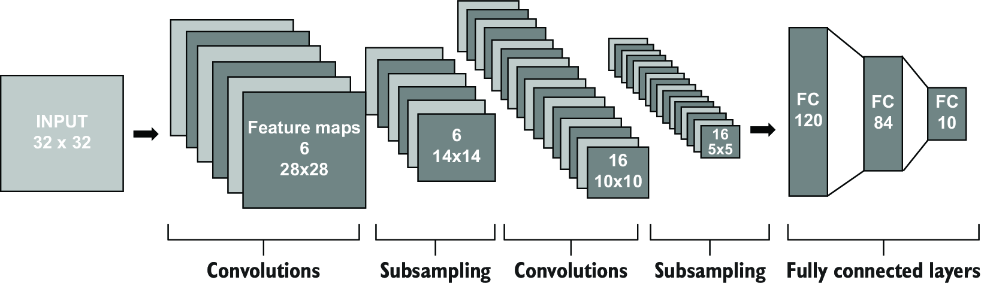
Use the architecture figure to trace the progression from convolution and activation through pooling to classification. section 10.2.1

















