A convolutional neural network is a neural network architecture for image recognition that preserves and exploits relationships among nearby pixels. It applies learned filters locally instead of treating each pixel as an isolated input. section 7.3.4
Its inductive bias comes from three linked operations:
- Slides a learned filter across the input in a moving window. section 7.3.4
- Propagates signals locally, normalizing and filtering activations at each locality. section 7.3.4
- Pools information between layers to combine local patterns into higher-level representations. section 7.3.4
Why locality matters
A perceptron receiving an image one pixel at a time loses the spatial order and struggles with object recognition. A convolutional network retains neighboring-pixel context through local filtering. section 7.3.4
Figure 7.6 Inductive bias in ML algorithms (adapted from Jumper, Evans, et. al. [6]. The sequence (a) through (e) is determined by the order in which these biases gained popularity in the ML community. The arrows indicate the propagation of signal across a network or in a graph.
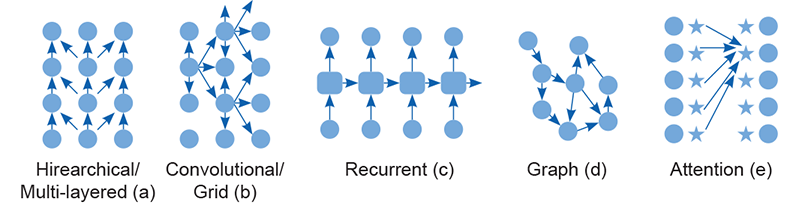
Compare convolutional networks with other inductive biases and network structures. section 7.3.4

















