The curse of dimensionality describes how statistical estimation, geometric coverage, and related computational tasks become harder as the number of dimensions grows. In chemical machine learning, a fixed number of molecules occupies high-dimensional descriptor space sparsely, weakening the meaning of distance and similarity. section 6.2.2 section 7.1
The difficulty has several practical consequences:
- Distance-based methods such as Kennard–Stone selection and clustering require pairwise distances, increasing computational cost with the number of samples and dimensions. section 6.2.2
- Data become increasingly sparse because the number of points needed to cover the space at a given density scales exponentially with dimensionality. section 6.2.3
- Sparse coverage can make distances less informative, while dimensions beyond three become difficult to visualize directly. section 6.2.2
A practical response is to exploit the blessing of non-uniformity: not every dimension is equally important. Principal component analysis compresses descriptors into orthogonal components ordered by explained variance, retaining a smaller representation while preserving important structure. Representative splitting can then select diverse training molecules that better align train and test distributions. section 6.5 section 6.2.3
RNA-target ligand modeling
A dataset containing 48 ligands represented by 191 descriptors sparsely populates its feature space. Kennard–Stone selection chooses samples that are maximally distant from those already selected, seeking a diverse subset that captures dataset variability and broadens the QSAR model’s applicability domain. section 6.2.2 section 6.2.3
Figure 6.8 Dimension x2 carries almost no information since the x2-values for each point barely deviate relative to the values along dimension x1. Conversely, the x1 dimension carries a lot of information and removing it would result in a compressed form of the data that is very dissimilar from the original data.
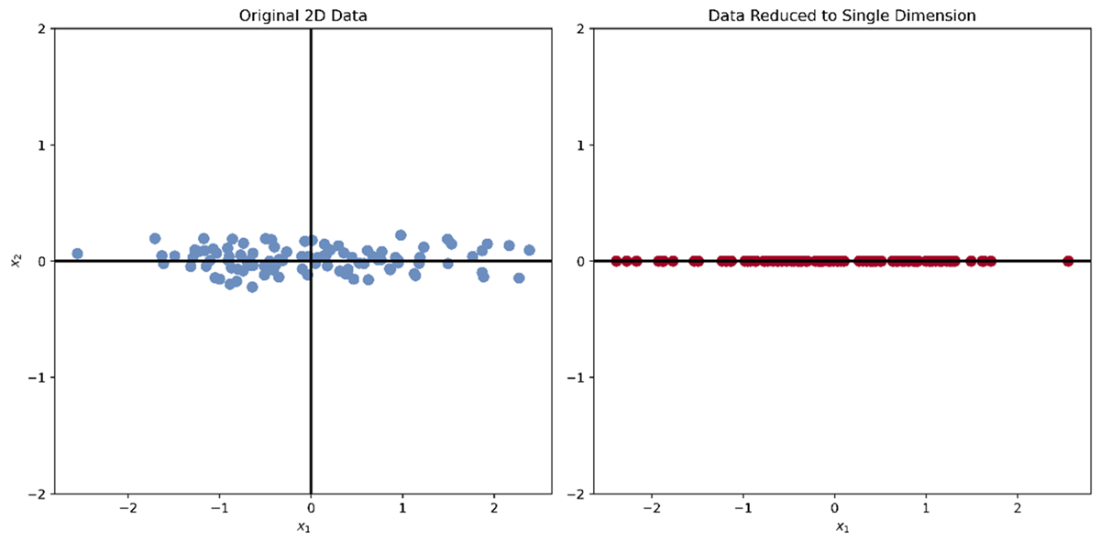
Use the figure to see how PCA preserves an informative direction while removing a dimension with little variation. section 6.2.3









