Data cleaning makes existing data usable by detecting mismatched formats, inconsistent values, and other obstacles to combining information. It can be a quick formatting adjustment—or reveal that the data needs a human-created mapping. section 9.3.1
Use data cleaning to:
- Standardize values when two systems describe the same thing differently but preserve a comparable structure. section 9.3.1
- Create or request a mapping key when values are structured so differently that software cannot reliably match them. section 9.3.1
When team names refuse to join
One system stores team names in uppercase without spaces; another uses inconsistent formats. A direct table join may return only a few matches. Light cleaning might fix formatting, but fundamentally different names require a mapping table linking each version. section 9.3.1
Figure 9.9 System A stores team names in the format on the left, uppercase with no spaces, while system B on the right doesn’t follow any particular format. If you try to join these tables on System A’s team name equals system B’s team name, you might, at best, get a few results, but certainly not all of them. You’ll need to find some way to link them.
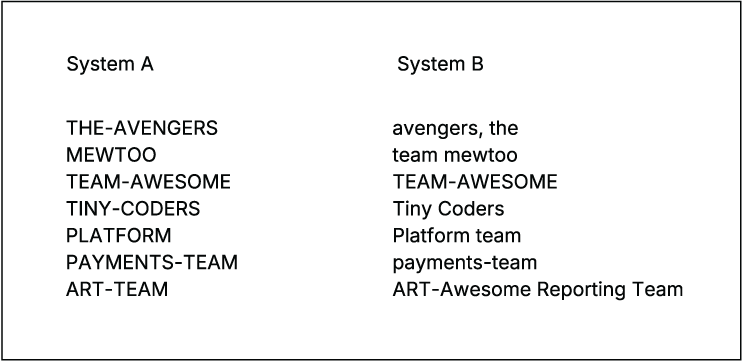
Compare the two team-name formats to see why an apparently simple join can fail. section 9.3.1













