A data model makes domain meaning explicit instead of hiding it behind flags, nulls, or overloaded fields. The right representation can make illegal states impossible to express and clarify the intentions behind assignments. section 1.7
A practical data model:
- Uses concrete types for business meanings rather than ambiguous conditional conventions. section 1.7
- Selects only the data needed for the task instead of reproducing an official entity with all its accumulated baggage. section 8.1
- Lets object-oriented code grow around descriptive data, complementing rather than replacing objects. section 1.7
- Makes methods communicate through descriptive inputs and return types instead of hiding information in zero-argument operations. section 1.7
Routing a customer account
Represent an account with an AccountId, Region, CountryCode, Sector, Segment, and SalesChannel. Enums capture bounded categories such as Enterprise, Direct, or EMEA, while a custom Sector record wraps an arbitrary string. This compact model supports business rules without exposing every field scattered across databases, data lakes, and services. section 8.1
Figure 8.3 Good modeling hides complexity we don’t care about.
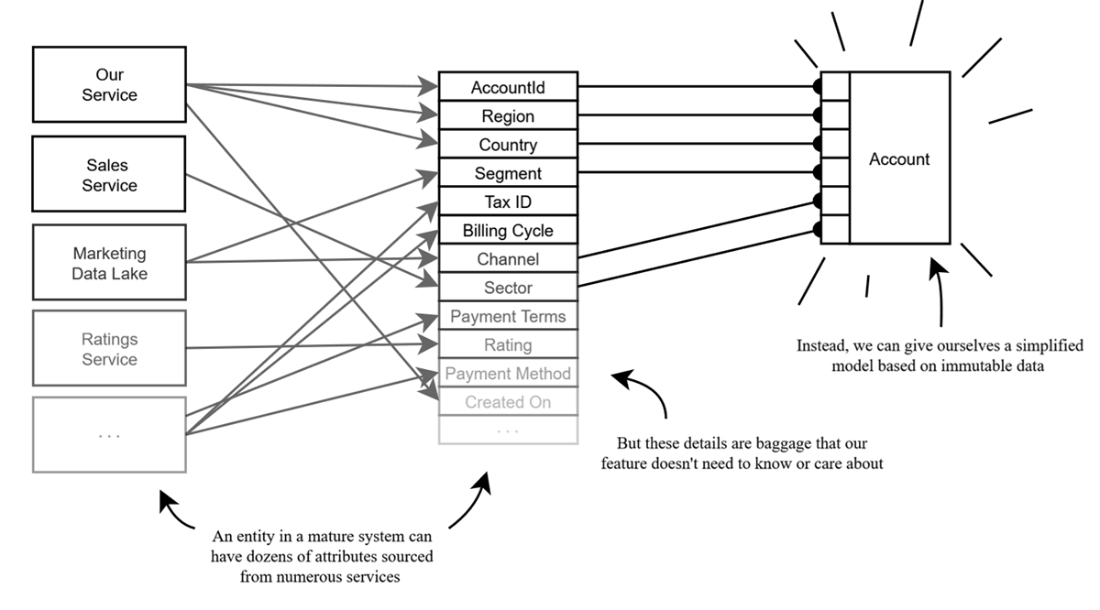
Shows how a focused data model hides infrastructure and entity complexity that the immediate business task does not require. section 8.1