A data model turns a clinical workflow into structured, traceable information. In an EHR, it represents actors, workflow state, captured data, and the patient identifier that anchors each event. This precision determines whether recorded information remains connected to what actually happened to the patient. section 2.2.3
Apply the model to every event by asking:
- Who acted, including clinicians, technicians, algorithms, or external API-connected systems? section 2.2.3
- What action occurred, how did it change the order or encounter state, and what data was captured? section 2.2.3
- For which patient was the event recorded, and which identifier reliably anchors it? section 2.2.3
CBC order timeline
When Dr. Meredith Brown signs a routine CBC order, the EHR changes the order from signed to active and records the test, priority, encounter, and signature time. Collection and analysis create further events, advance workflow state, and record the responsible actors, all linked to the patient’s MRN. section 2.2.3
Figure 2.5 The divergence between complex clinical reality and structured system data.
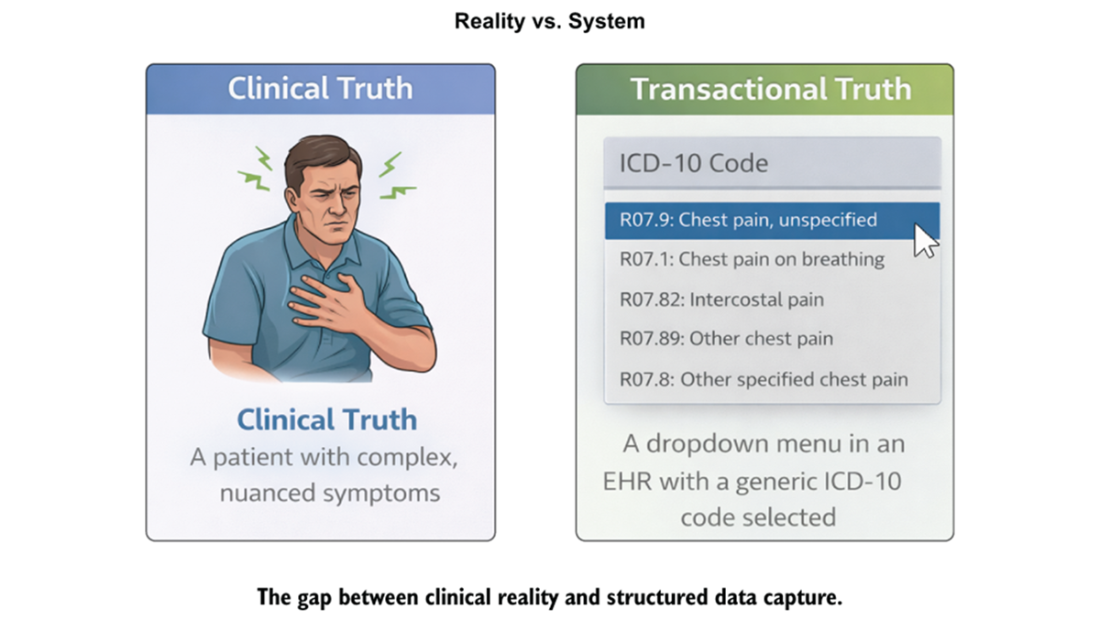
Use the figure to compare complex clinical reality with the structured data required to represent it reliably. section 2.2.3