liveBook · Manning

Dimensionality reduction

As explained in Grokking Machine Learning

A technique that simplifies data by reducing or combining features while preserving as much information as possible.

Dimensionality reduction simplifies data by combining similar features and reducing the number of columns while losing as little information as possible. It is an unsupervised-learning technique that can also preprocess data for supervised learning. section 2.5

Figure 2.7 Dimensionality reduction algorithms help us simplify our data. On the left, we have a housing dataset with many features. We can use dimensionality reduction to reduce the number of features in the dataset without losing much information and obtain the dataset on the right.
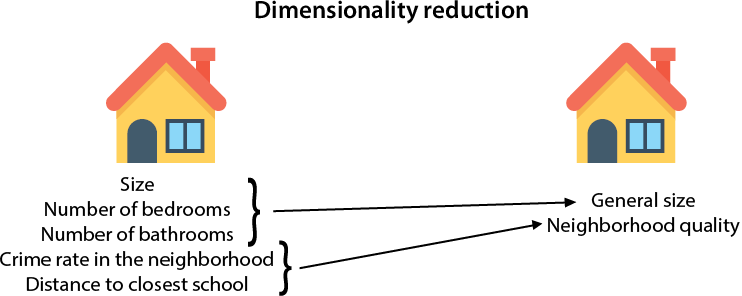
A housing dataset with many features becomes simpler by using fewer features while retaining much of its information. section 2.3

Dimensionality reduction and clustering simplify data in different ways:

  • Dimensionality reduction reduces columns, while clustering can reduce rows by grouping data points. section 2.3


How Grokking Machine Learning covers it

How deep it goes
Defines feature reduction and illustrates fewer columns, but does not detail an algorithm.
Examples
Uses a housing dataset with many features to illustrate reducing features while retaining much of the information.
What you can do after
Understand how reducing columns can simplify a dataset while retaining much of its information.
How it connects
Connects dimensionality reduction to unsupervised learning, preprocessing, clustering, matrix factorization, and singular value decomposition.

Also explained in

Compare how 11 books explain dimensionality reduction →

Related concepts

This explainer was generated by Manning's knowledge graph from the text of Grokking Machine Learning. The section links point to the parts of the book it draws on.







